








SDHI to expand shipbuilding capacity with new Goliath crane as India scales up maritime ambitions
India’s push to establish itself as a global shipbuilding hub is gathering pace, with Swan Defence and Heavy Industries Limited (SDHI) announcing plans to significantly expand heavy-lift...

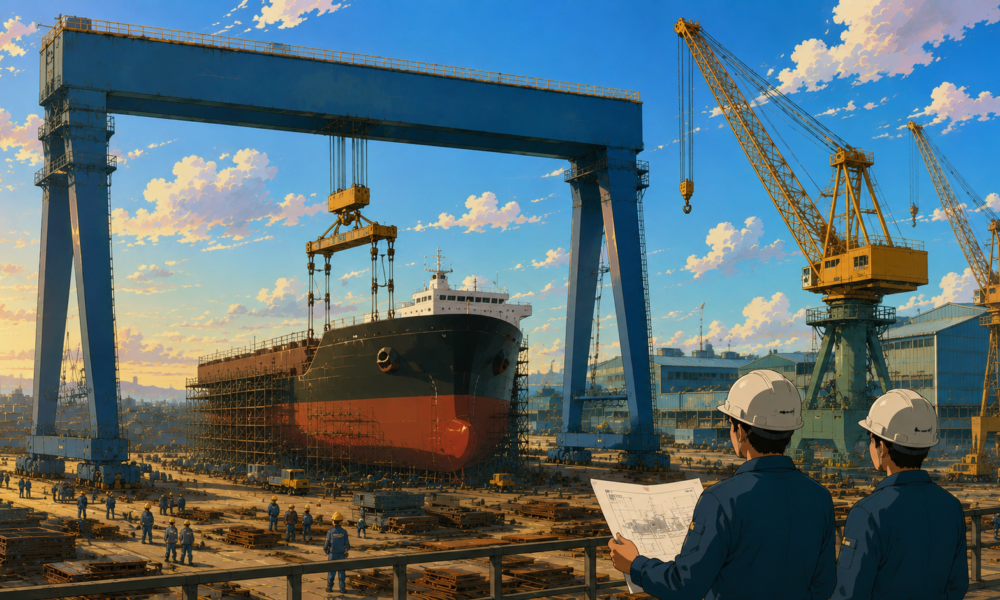
India’s push to establish itself as a global shipbuilding hub is gathering pace, with Swan Defence and Heavy Industries Limited (SDHI) announcing plans to significantly expand heavy-lift infrastructure at its Pipavav shipyard in Gujarat. The company will install another Goliath crane, alongside two electrical level luffing cranes, in a move aimed at increasing production capacity, improving operational efficiency and strengthening India’s maritime manufacturing ecosystem.
The centrepiece of the expansion is a new Goliath crane with a lifting capacity of 600 tonnes or more. Scheduled for commissioning over the next 18 to 24 months, the crane will allow SDHI to undertake multiple shipbuilding projects simultaneously while reducing construction timelines for large commercial and defence vessels. The investment reflects growing demand for advanced shipbuilding infrastructure as India seeks to capture a larger share of the global maritime manufacturing market.
Heavy-lift cranes are among the most critical assets in modern shipyards. They enable massive steel sections, engines and pre-fabricated ship modules to be assembled with greater precision and speed. By adding another Goliath crane, SDHI expects to improve yard throughput while increasing flexibility across multiple vessel construction programmes.
The expansion also includes two 40-tonne electrical level luffing cranes. Unlike conventional cranes, level luffing systems maintain a constant hook height while moving loads horizontally, allowing shipbuilders to position heavy components more accurately during assembly. The technology is expected to improve productivity while enhancing safety across fabrication and outfitting operations.
The investment builds on one of India’s most significant maritime assets. SDHI’s Pipavav facility houses the country’s largest dry dock, measuring 662 metres in length and 65 metres in width. The dock is also counted among the world’s seven largest dry docks and is capable of constructing vessels of up to 400,000 deadweight tonnes. These include Very Large Crude Carriers (VLCCs), Very Large Gas Carriers (VLGCs), Aframax tankers, Panamax vessels and Kamsarmax bulk carriers.
A key operational advantage of the facility lies in its modular design. The dry dock can be divided into three independent sections, allowing large, medium and smaller vessels to be built at the same time. This configuration improves dock utilisation, shortens project cycles and increases annual production capacity, making the yard more competitive in both commercial and defence shipbuilding.
SDHI has also adopted modular construction techniques to accelerate vessel production. Steel blocks weighing between 80 and 350 tonnes are fabricated separately before being combined into mega blocks of around 600 tonnes. These large sections are then lifted into position using Goliath cranes, reducing assembly time and improving overall construction efficiency. The addition of another heavy-lift crane is expected to further streamline this process.
According to Rear Admiral (Retd.) Vipin Kumar Saxena, Chief Executive Officer of SDHI Shipyard, the infrastructure expansion is aligned with India’s broader maritime development strategy and will significantly enhance the yard’s production capability. Industry estimates suggest that a Goliath crane of this scale could require an investment of ₹400 crore to ₹500 crore, underlining the company’s long-term commitment to expanding domestic shipbuilding infrastructure.
The development comes at a time when India is intensifying efforts to strengthen its maritime sector through higher domestic manufacturing, increased defence production and greater export competitiveness. As global supply chains diversify and governments invest in strategic industrial capacity, large integrated shipyards equipped with advanced heavy engineering infrastructure are expected to play a central role in meeting future demand.
For India’s infrastructure sector, SDHI’s latest investment represents more than an expansion of a single shipyard. It highlights the growing importance of world-class industrial facilities in supporting manufacturing, logistics, defence preparedness and maritime trade. With larger lifting capacity and improved operational flexibility, the Pipavav shipyard is positioning itself to contribute more significantly to India’s ambition of becoming a leading global centre for shipbuilding and marine engineering.








No Comment! Be the first one.