








India’s Data Centre Pipeline Reaches 3,860 MW as AI Infrastructure Demand Accelerates
India’s data-centre infrastructure expansion is gathering pace, with the country’s development pipeline expected to reach 3,860 MW by 2030, according to Cushman & Wakefield’s India Data Centre H1...

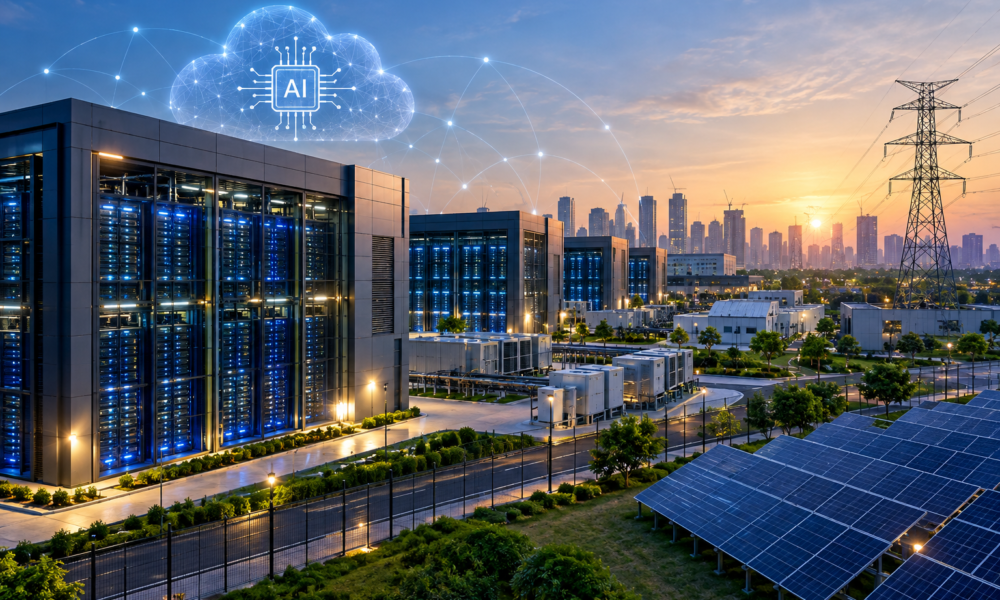
India’s data-centre infrastructure expansion is gathering pace, with the country’s development pipeline expected to reach 3,860 MW by 2030, according to Cushman & Wakefield’s India Data Centre H1 2026 Update released on September 23, 2026. The growth is being driven by rising artificial intelligence (AI) adoption, hyperscale cloud requirements and the digital transformation of businesses.
The report said India’s top seven data-centre markets added 178 MW of new capacity during the first half of 2026, taking the country’s total operational capacity to 1,789 MW by the end of June. This represents continued expansion as businesses and technology companies require greater computing, storage and connectivity infrastructure.
Mumbai continues to be India’s largest data-centre market, while development is increasingly spreading across other major cities. The expansion reflects the growing importance of reliable power, digital connectivity and access to large-scale infrastructure for data-intensive industries.
The broader Asia-Pacific market is also expected to see substantial growth. Cushman & Wakefield estimates that regional data-centre capacity could increase 2.7 times by 2030, requiring more than US$280 billion in capital expenditure. India is expected to account for nearly US$29.9 billion of development capital during this expansion.
The growth of AI is particularly important for the next phase of data-centre development. AI workloads require high-performance computing infrastructure and can significantly increase electricity and cooling requirements. This is pushing developers and investors to pay greater attention to power availability, network connectivity, land and the ability to scale facilities.
Government policy is also increasingly focused on creating infrastructure conditions for the sector. Earlier this month, the government highlighted the need for data-centre-ready land banks and power-ready parcels, alongside faster approvals and appropriate building regulations. The National Building Code 2026 also specifically recognises data centres under Group E and includes dedicated requirements for the sector.
The investment momentum extends beyond physical capacity. CBRE reported that India recorded US$173 billion in cumulative data-centre investment commitments between 2021 and the first half of 2026, including US$38 billion announced during H1 2026 alone. Operational capacity stood at approximately 1.75 GW at the end of H1 2026, according to CBRE.
For India’s infrastructure sector, the data-centre boom means demand is moving beyond conventional commercial real estate. Developers increasingly need to integrate power infrastructure, fibre connectivity, cooling systems, renewable energy and highly resilient facilities into large-scale projects.
The next phase of India’s digital infrastructure build-out will therefore depend not only on how quickly new data centres can be constructed, but also on whether cities and states can provide the land, electricity, connectivity and regulatory environment required to operate them at scale.
Why it matters: The expansion of data centres could create new demand for industrial land, power infrastructure, construction, renewable energy, fibre networks and specialised real estate, making digital infrastructure an increasingly important component of India’s wider infrastructure economy.








No Comment! Be the first one.