







Delhi-NCR’s Flooding Problem Is Bigger Than Heavy Rain. Is Urban Infrastructure Failing?
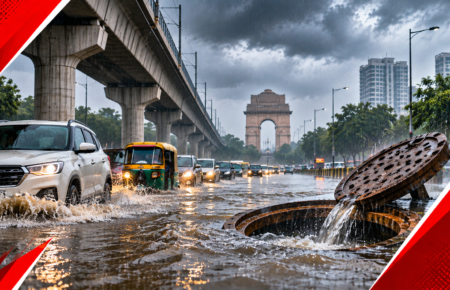
Every monsoon, waterlogged roads, stranded vehicles and disrupted commutes return to parts of Delhi-NCR. While intense rainfall is an important factor, the region’s recurring flooding problem...


Every monsoon, waterlogged roads, stranded vehicles and disrupted commutes return to parts of Delhi-NCR. While intense rainfall is an important factor, the region’s recurring flooding problem also raises questions about drainage capacity, urban planning and the protection of natural water channels.
For residents of Delhi-NCR, monsoon rainfall often brings an additional commuting challenge.
Roads become waterlogged, traffic slows down and neighbourhoods struggle with overflowing drains.
These incidents are frequently described as the consequences of heavy rainfall.
But rainfall alone does not explain why several urban locations struggle to manage stormwater.
The underlying problem is also connected to how cities are designed, developed and maintained.
Why Urban Areas Flood
According to the Ministry of Housing and Urban Affairs, urban flooding can be intensified by high-intensity rainfall over short periods, unplanned urbanisation, encroachment of natural water bodies and inadequate drainage infrastructure.
As cities expand, open land and natural surfaces are increasingly replaced by roads, buildings and paved spaces.
These surfaces reduce the amount of rainwater that can naturally seep into the ground.
Consequently, a greater volume of water flows across roads and enters drainage networks within a short period.
If those systems cannot handle the flow, water accumulates in low-lying areas.
The Drainage Infrastructure Challenge
Stormwater drainage is a critical part of urban infrastructure.
However, installing drains is not enough.
Their capacity, design, connectivity and regular maintenance determine how effectively they function during heavy rainfall.
Blocked drains, poorly maintained channels and disconnected drainage networks can prevent water from flowing towards designated discharge points.
Urban flooding can also become worse when construction activity interferes with natural drainage channels.
Delhi’s proposed drainage planning has therefore become an important part of the wider conversation about climate resilience.
Delhi’s ₹57,000 Crore Drainage Master Plan
Delhi’s Drainage Master Plan 2025, reported by The Indian Express, involves a proposed investment of approximately ₹57,000 crore and a long-term approach to improving drainage across the city’s three major basins.
The reported plan includes approximately 18,000 kilometres of drains.
The scale of the proposal highlights how substantial the challenge is.
However, the success of any drainage strategy will depend on implementation, funding, coordination and regular maintenance.
Why Noida and Greater Noida Need Attention Too
Delhi-NCR functions as an interconnected urban region.
People travel across Noida, Greater Noida, Ghaziabad, Gurugram and Delhi every day.
Infrastructure planning in one city can therefore affect mobility and resilience across neighbouring areas.
As residential and commercial development expands, authorities must ensure that drainage networks, sewage systems and natural water channels are planned alongside new construction.
Real estate development without adequate supporting infrastructure can increase long-term pressure on urban services.
What Needs to Change?
Urban planners need to move beyond emergency responses during the monsoon.
Cities require updated drainage maps, regular desilting, protection of natural water bodies, rainwater harvesting and improved coordination between civic authorities.
Developers must also comply with applicable stormwater management and environmental requirements.
Technology, including rainfall monitoring and flood forecasting systems, can help authorities prepare for extreme weather.
However, technology cannot compensate for inadequate physical infrastructure.
A modern city should not be judged only by its expressways, skyscrapers and commercial districts. It should also be judged by whether its roads remain functional when it rains.







No Comment! Be the first one.