








India’s Data Centre Boom Spurs Demand for New Power and Transmission Infrastructure
India’s rapidly expanding data centre industry is creating a new infrastructure challenge. The facilities that power cloud computing, artificial intelligence and digital services are demanding...

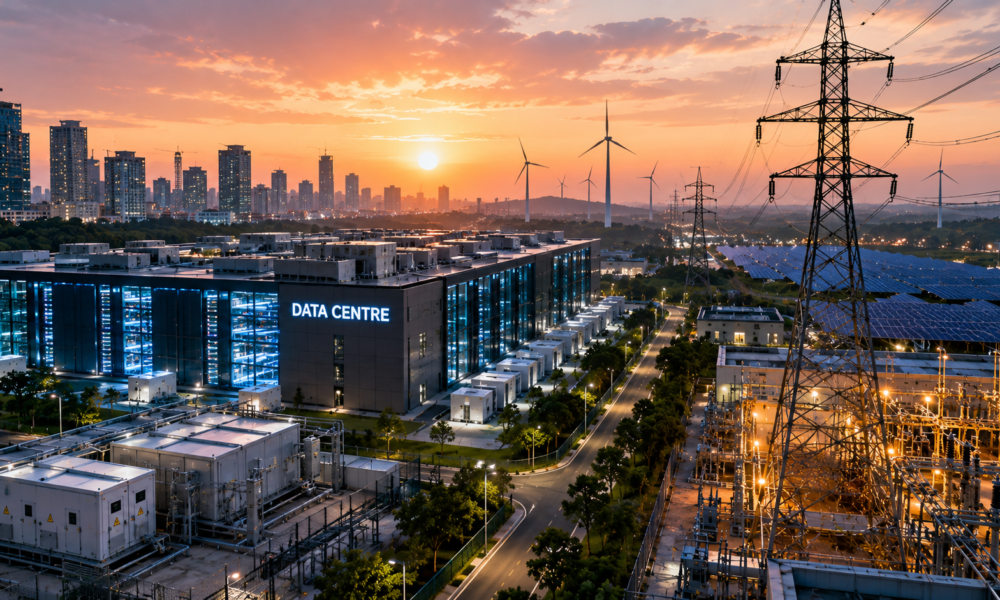
India’s rapidly expanding data centre industry is creating a new infrastructure challenge. The facilities that power cloud computing, artificial intelligence and digital services are demanding unprecedented levels of electricity, forcing states and infrastructure developers to rethink how power is generated, transmitted and managed.
Industry estimates suggest India’s data centre capacity is expected to more than double over the next few years, driven by growing internet usage, digital payments, artificial intelligence applications and cloud adoption by businesses and governments. The expansion is triggering large investments not only in data centres but also in the supporting infrastructure that keeps them running.
Unlike traditional commercial buildings, data centres consume enormous amounts of electricity around the clock. A single hyperscale data centre can require as much power as a medium-sized city. As India seeks to attract investments in artificial intelligence and digital services, ensuring uninterrupted power supply has become a critical infrastructure priority.
Major data centre clusters are emerging in Mumbai, Chennai, Hyderabad, Bengaluru and the National Capital Region. These cities are witnessing rising demand for high-capacity substations, dedicated transmission lines and renewable energy sources that can meet the operational requirements of next-generation computing facilities.
Infrastructure developers are increasingly investing in captive renewable energy projects and battery storage systems to support data centre operations. Industry experts believe power infrastructure could become the biggest enabler, and potentially the biggest constraint, for the next phase of India’s digital growth.
The challenge extends beyond electricity generation. Data centres require resilient transmission networks capable of maintaining uninterrupted operations even during peak demand periods. Any disruption can affect banking systems, digital payment platforms, cloud applications and public digital services that millions of Indians rely upon every day.
The rise of artificial intelligence is expected to further accelerate electricity consumption. AI workloads demand significantly greater computing power than conventional applications and require advanced cooling systems that add to energy requirements. Global technology companies are increasingly selecting locations based not only on connectivity and land availability but also on access to reliable and sustainable power infrastructure.
India’s policy push towards renewable energy may offer a strategic advantage. The country is expected to cross 300 GW of non-fossil power capacity this year and continues to expand transmission networks and battery storage infrastructure. These investments could help position India as an attractive destination for large-scale data centre development.
For infrastructure companies, the opportunity extends far beyond constructing data facilities. It includes transmission corridors, renewable energy projects, grid modernisation, cooling technologies, industrial water systems and energy storage infrastructure.
As digital technologies become central to economic activity, data centres are emerging as critical national infrastructure. Their growth is increasingly reshaping investment priorities and creating demand for a new generation of power and utility infrastructure that will underpin India’s digital economy in the coming decade.








No Comment! Be the first one.