







Expanding India’s Aviation Landscape: Noida International Airport Commences Operations
Noida International Airport at Jewar has begun commercial operations, marking a major milestone in India’s airport infrastructure buildout and adding a second full-scale international aviation...

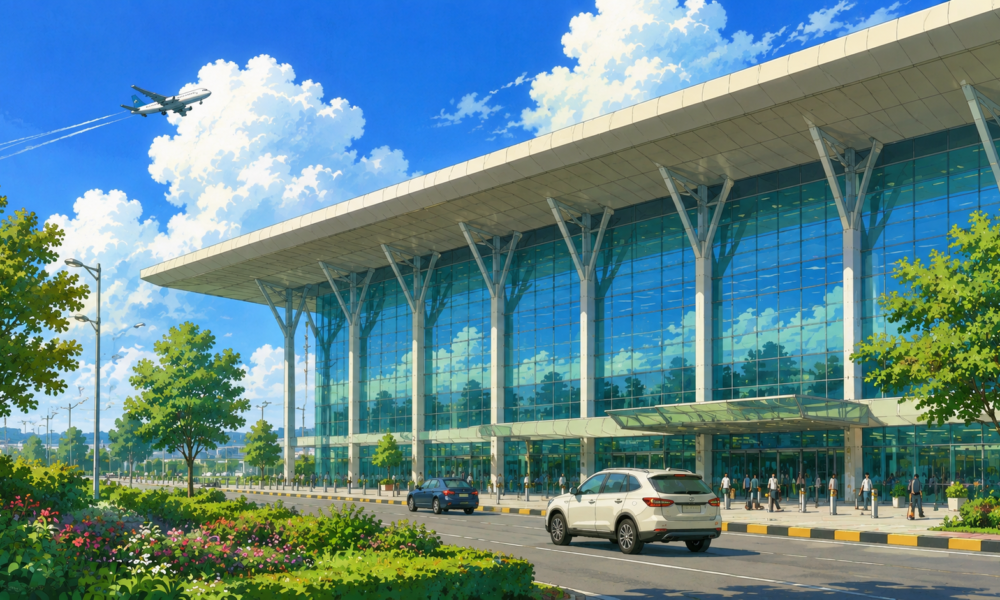
Noida International Airport at Jewar has begun commercial operations, marking a major milestone in India’s airport infrastructure buildout and adding a second full-scale international aviation gateway to the Delhi-NCR region. The greenfield airport, developed under a public-private partnership model, is expected to play a significant role in redistributing passenger traffic, strengthening regional connectivity and accelerating economic activity across western Uttar Pradesh and adjoining areas.
The first phase of the airport has been developed at an estimated cost of around ₹11,200 crore and is designed with an initial passenger handling capacity of 12 million passengers per annum. Airport executives have indicated that passenger traffic could touch around 60 lakh in the first year, with the facility expected to gradually ramp up operations as airlines expand their schedules and route networks from the new hub.
Located in Jewar in Gautam Buddh Nagar district, the airport is being positioned not simply as an overflow facility for Delhi’s Indira Gandhi International Airport, but as a major aviation node with its own catchment area. That catchment extends across eastern parts of the National Capital Region, western Uttar Pradesh and neighbouring regions of Haryana. This is central to the airport’s business case: rather than competing only for existing Delhi flyers, it aims to unlock new demand from regions that have historically depended on long surface journeys to reach IGI Airport.
The project has been developed by Yamuna International Airport Private Limited, a subsidiary of Zurich Airport International, and has been executed with Tata Projects as the engineering, procurement and construction contractor for the airport infrastructure. The terminal and associated facilities have been designed around a phased growth model, allowing the airport to scale as traffic builds up. In the longer run, the project is planned to grow into one of the country’s largest aviation hubs, with eventual passenger capacity targeted far above the opening phase.
What makes the airport particularly important from an infrastructure standpoint is its multi-modal ambition. The airport sits close to the Yamuna Expressway and is expected to be supported by a web of road, metro, rail and regional transport links over time. That matters because airport-led development increasingly depends not just on runway capacity or terminal design, but on how efficiently passengers, cargo and airport workers can move to and from the site. In the case of Jewar, the state government and project stakeholders have repeatedly framed the airport as a broader logistics and growth anchor rather than a standalone aviation asset.
Cargo is another major part of that strategy. Plans around Noida International Airport include an integrated cargo and logistics ecosystem intended to support exports, e-commerce, electronics, perishables and manufacturing supply chains in the region. With western Uttar Pradesh emerging as a significant industrial and warehousing belt, the airport is expected to complement not only passenger travel but also air freight and high-value logistics.
The launch also reflects the scale of India’s current airport expansion cycle. For policymakers, the airport represents more than an additional runway in NCR; it is a test case for how greenfield aviation infrastructure can be used to shape regional growth, attract investment and improve access to air travel outside traditional metropolitan cores. For Uttar Pradesh, the project carries added political and economic weight because it aligns with the state’s larger push to build expressways, industrial corridors, logistics parks and urban clusters around new transport assets.
Operationally, the airport will still need to prove itself over the coming months. Traffic ramp-up, airline participation, seamless landside connectivity and timely execution of subsequent phases will determine whether it can meet its long-term promise. But its opening already marks a structural shift in north India’s aviation map. Delhi-NCR is no longer dependent on a single major airport ecosystem, and western Uttar Pradesh now has a new piece of transport infrastructure that could reshape mobility, investment and urban development across the region.







No Comment! Be the first one.