





India’s first undersea rail tunnel gathers pace as second TBM begins excavation
India’s ambition to build world-class transport infrastructure has reached another milestone with the launch of the second Tunnel Boring Machine (TBM) for the country’s first undersea...

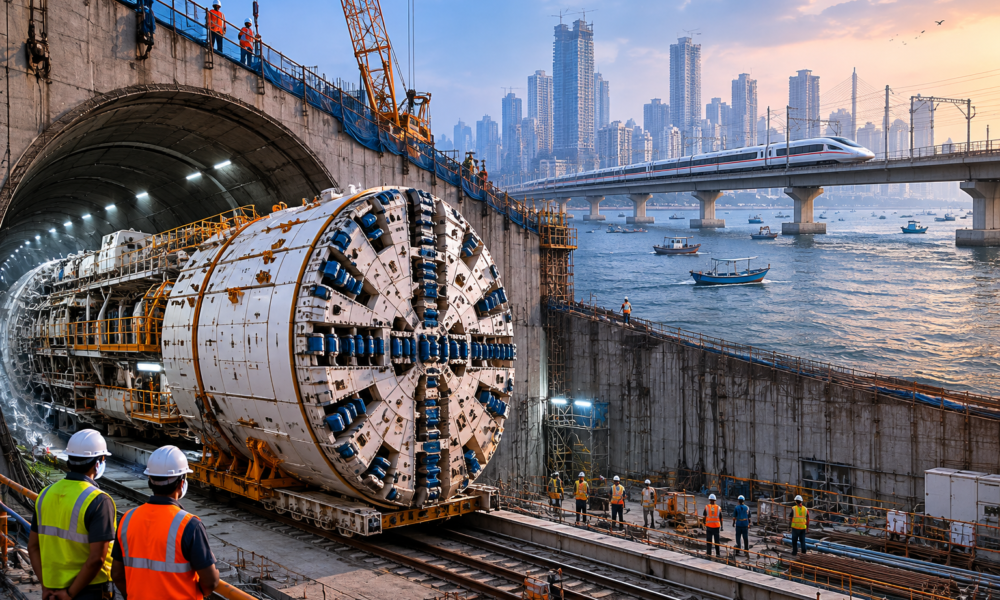
India’s ambition to build world-class transport infrastructure has reached another milestone with the launch of the second Tunnel Boring Machine (TBM) for the country’s first undersea rail tunnel beneath Thane Creek. The development is part of the Mumbai to Ahmedabad High Speed Rail Corridor, one of India’s largest infrastructure projects, and marks significant progress towards delivering the nation’s first bullet train network.
The newly deployed TBM has started excavating from Sawli near Ghansoli towards Vikhroli in Maharashtra. It will construct a 10 km underground tunnel, of which around 7 km will pass beneath Thane Creek, making it India’s first railway tunnel built under the sea. The first TBM had already begun its journey from Vikhroli towards Bandra Kurla Complex earlier this month, while a separate 5 km section has already been completed using the New Austrian Tunnelling Method.
The complete underground stretch measures 21 km, including 16 km that will be excavated using Tunnel Boring Machines. The tunnel has been designed to safely pass beneath densely populated urban areas, major roads, rivers and critical public infrastructure without disrupting life above ground. Once completed, it will become one of the most technically advanced railway tunnels in the country.
Engineering such a tunnel requires exceptional precision. Each Tunnel Boring Machine weighs thousands of tonnes and is equipped with automated guidance systems that continuously monitor its position beneath the ground. The machines install concrete lining segments immediately after excavation, ensuring structural stability while allowing work to continue around the clock.
The undersea section beneath Thane Creek presents additional engineering challenges due to varying soil conditions, groundwater pressure and the sensitive coastal environment. Project teams have incorporated advanced monitoring systems to minimise environmental impact while maintaining construction safety throughout the excavation process.
Beyond showcasing engineering capability, the project reflects India’s broader push towards modern, high-speed and sustainable transport infrastructure. High speed rail is expected to reduce travel time between Mumbai and Ahmedabad to around two hours, providing an alternative to road and air travel while supporting economic activity across western India.
Large infrastructure investments such as this also generate employment across construction, engineering, manufacturing and technology sectors. Domestic suppliers are contributing equipment, concrete segments, steel components and specialised engineering services, creating wider economic benefits throughout the supply chain.
The successful progress of the country’s first undersea railway tunnel is likely to influence future transport projects that require underground construction beneath rivers, coastlines and densely built cities. Lessons from the Mumbai Ahmedabad corridor could strengthen India’s expertise in complex tunnelling technologies, making future metro, railway and highway projects more efficient.
As excavation continues from both ends, the project moves another step closer to delivering one of India’s most ambitious transport corridors. For the infrastructure sector, the second TBM launch is more than a construction update. It represents growing confidence in India’s ability to execute technically demanding projects that meet international engineering standards while supporting long-term economic growth.



No Comment! Be the first one.