








NCR Real Estate Enters New Growth Cycle as Office Demand Hits Record High
India’s commercial real estate market recorded its strongest first half of 2026 on record, with office absorption reaching approximately 45.5 million sq ft and new supply touching 32 million sq...

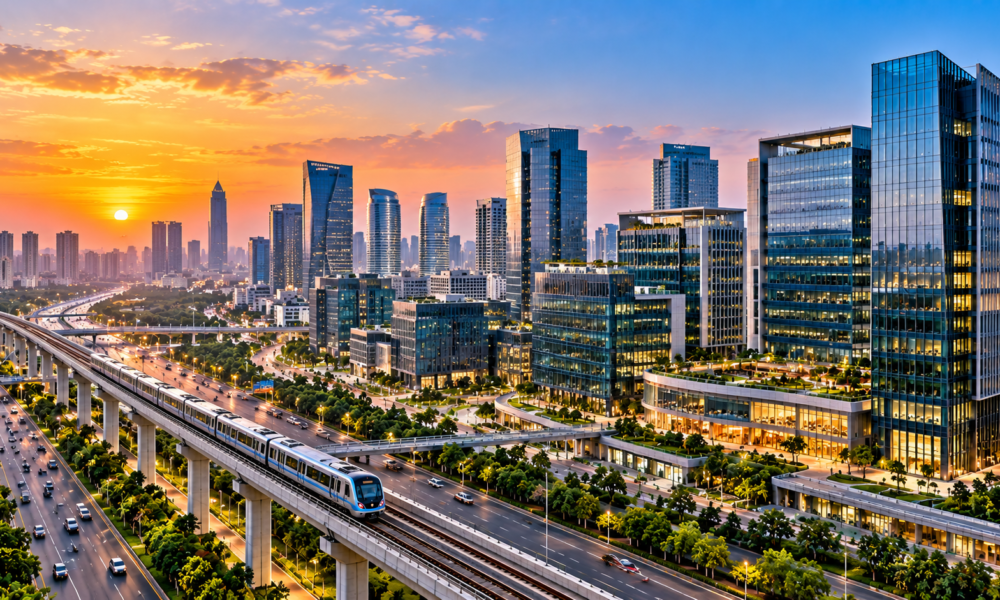
India’s commercial real estate market recorded its strongest first half of 2026 on record, with office absorption reaching approximately 45.5 million sq ft and new supply touching 32 million sq ft, according to CBRE.
The figures point to sustained demand for office space even as developers continue adding large volumes of new supply. In Q2 2026 alone, India’s office sector recorded approximately 24.6 million sq ft of gross leasing, the highest quarterly figure recorded by CBRE.
The first-half absorption figure of 45.5 million sq ft was the highest recorded for any half-year period. New completions also reached a record 32 million sq ft during January-June 2026.
Delhi-NCR was among the major markets contributing to this activity. Bengaluru, Pune and Delhi-NCR together accounted for 58% of quarterly office leasing in Q2, according to CBRE.
One of the major drivers of demand is the continued expansion of Global Capability Centres, or GCCs. GCCs absorbed approximately 19.6 million sq ft during H1 2026, accounting for around 43% of total half-year office leasing and representing a 17% year-on-year increase.
Flexible workspace operators are another important source of demand. They accounted for 27% of quarterly leasing, followed by technology companies at 21% and BFSI companies at 13%. This indicates that the office market is being shaped by a combination of technology, financial services, flexible workspaces and multinational corporate expansion.
The growth is also extending beyond traditional commercial districts in the National Capital Region. Recent market reporting points to increasing commercial, retail and residential development across Noida, Greater Noida and the Yamuna Expressway region.
For developers and investors, this expansion creates opportunities but also increases the importance of location and asset quality. The ability of individual projects to attract occupiers depends on connectivity, building specifications, sustainability credentials and access to surrounding residential and transport infrastructure.
Sustainability is becoming particularly important. CBRE reported that green-certified buildings accounted for 76% of office completions in Q2 2026, while 73% of leasing activity was concentrated in green-certified buildings.
This trend could influence future development across NCR. As companies increasingly consider energy efficiency and sustainability in their workplace strategies, developers may need to incorporate green-building features into new commercial projects.
The relationship between office development and residential real estate is also becoming increasingly visible. As employment centres expand into areas such as Noida, Greater Noida and the Yamuna Expressway corridor, demand for housing, retail, hospitality and transport infrastructure can develop around them.
Data centres are another emerging component of the broader commercial infrastructure landscape. Cushman & Wakefield estimates that Delhi-NCR currently has around 183 MW of operational data-centre capacity and another 387 MW in upcoming supply.
The result is a more diversified NCR real estate market, with office campuses, GCCs, flexible workspaces, data centres, retail projects and residential developments influencing one another.
The H1 2026 numbers do not guarantee that every submarket will experience identical growth. However, they do demonstrate that India’s office sector entered the second half of 2026 with historically high levels of demand and supply.
For NCR, the next phase will depend on how effectively developers, infrastructure agencies and occupiers respond to this expanding demand across multiple real estate categories.






No Comment! Be the first one.