








Tractor Demand in India: What Rising Farm-Equipment Sales Mean for Rural Infrastructure and Agricultural Mechanisation
India’s tractor market continued to expand in August 2026, although different datasets show a more moderate pace of growth than the strong expansion recorded earlier in the year. Mahindra &...

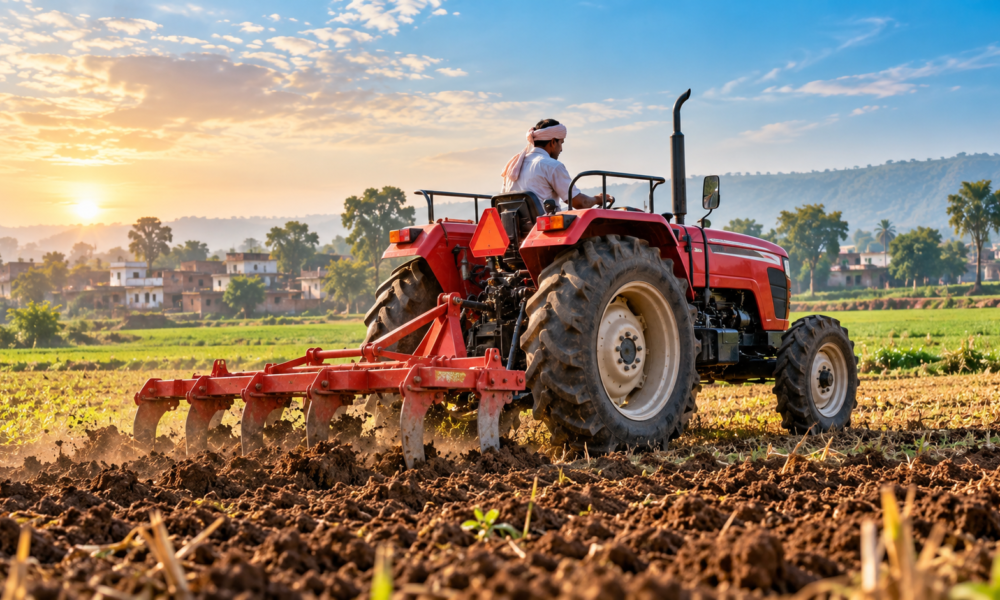
India’s tractor market continued to expand in August 2026, although different datasets show a more moderate pace of growth than the strong expansion recorded earlier in the year.
Mahindra & Mahindra reported domestic tractor sales of 27,595 units in August 2026, up 5% from 26,201 units in August 2025. Its cumulative domestic sales through August were 212,664 units, up 17% year on year.
Industry-wide retail data from the Federation of Automobile Dealers Associations, however, showed a much more modest 0.84% year-on-year increase to 87,977 units in August. FADA also reported that rural tractor registrations increased 3.09%, while urban registrations declined 8.32%.
The difference between wholesale and retail numbers is important because it shows that tractor demand is closely tied to farm conditions and purchasing cycles.
ICRA reported that wholesale tractor volumes increased 6.5% year on year in August, while retail volumes increased only 0.8%. It also linked demand conditions to monsoon performance and noted that FY2027 growth could moderate following strong growth in FY2026.
Why does this matter to infrastructure?
Agricultural mechanisation depends on more than tractors themselves. Farmers need roads capable of supporting movement between villages and fields, fuel availability, repair centres, spare-parts networks, warehouses and agricultural markets.
A tractor can increase farm productivity, but its economic value depends partly on the infrastructure surrounding it.
Better rural roads make it easier to transport agricultural machinery and harvested produce. Reliable electricity can support workshops and farm-processing facilities. Warehouses and cold chains can help farmers move beyond immediate local markets.
Mechanisation also changes the rural labour equation. When tractors and other equipment reduce the time required for ploughing, harvesting or transport, farmers can potentially cultivate larger areas or complete agricultural operations within tighter weather windows.
The current sales data also show why rainfall remains an important variable. August tractor demand was affected by uneven monsoon conditions, with ICRA describing monsoon stress as a factor behind muted retail growth.
Government machinery-support programmes can also influence purchasing decisions. ICRA notes that the Sub-Mission on Agricultural Mechanization provides subsidies ranging from 50% to 80% for eligible agricultural machinery purchases.
For India’s rural infrastructure story, tractor sales therefore provide a useful economic indicator.
They show whether farmers are investing in productive assets and whether the surrounding ecosystem of roads, finance, machinery services and agricultural markets is capable of supporting that investment.





No Comment! Be the first one.