








India’s Data Centre Boom Faces a New Challenge: Can Cities Supply Enough Power and Water?
India’s data centre industry is expanding as businesses invest in cloud computing, digital services and artificial intelligence. These facilities provide the physical infrastructure needed to...

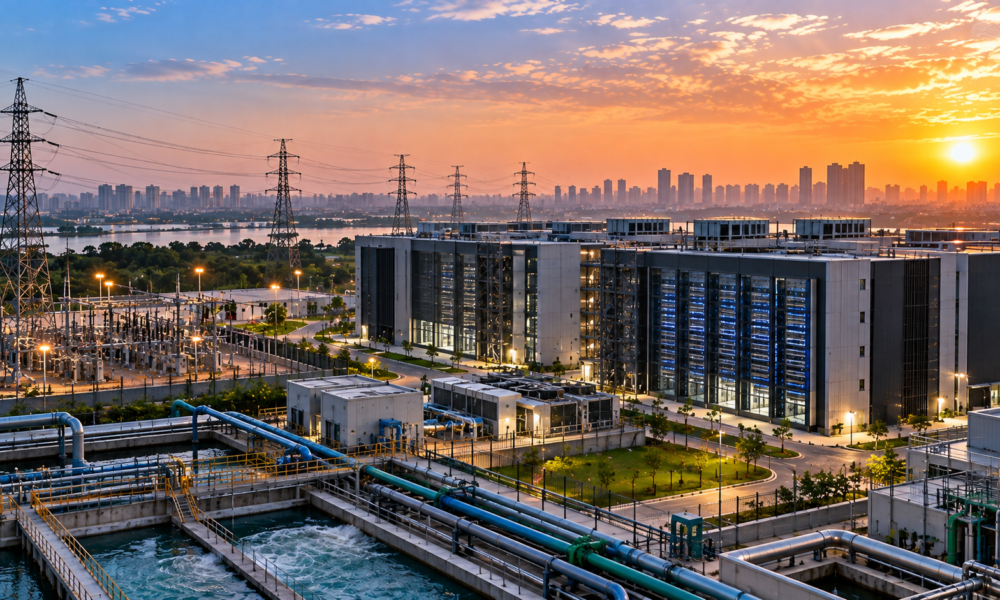
India’s data centre industry is expanding as businesses invest in cloud computing, digital services and artificial intelligence. These facilities provide the physical infrastructure needed to store, process and move enormous quantities of data. But their growth is creating a wider infrastructure question: can cities provide the electricity, water and supporting services that large data centres require?
India’s operational data centre capacity is expected to approach 2 gigawatts by the end of 2026, according to recent industry estimates. Mumbai remains a major market, while Delhi-NCR, Chennai and other cities are attracting investment. The expansion offers economic opportunities, but it also makes energy planning, water management and community engagement increasingly important.
Why Data Centres Are Expanding
Data centres house servers, networking equipment and storage systems used by businesses, government agencies and digital platforms. The growth of cloud computing and AI has increased demand for facilities that can handle intensive workloads and provide reliable services.
India offers several advantages, including a large digital economy, growing enterprise demand and established technology markets. Connectivity, access to customers and the availability of suitable industrial land also influence where operators build facilities.
However, a data centre is not an ordinary commercial building. It requires dependable power, cooling systems, backup arrangements, network connectivity and strict operational controls.
As facilities become larger and computing requirements increase, their demands on local infrastructure can also rise.
The Electricity Challenge
Reliable electricity is fundamental to data centre operations. Even a short interruption can disrupt services, making power quality, redundancy and backup systems central to facility design.
Large developments can also add pressure to local electricity networks. Utilities must plan for additional demand, reinforce distribution systems where necessary and coordinate capacity expansion with construction schedules.
Renewable energy procurement can help operators manage their emissions, but matching electricity demand with lower-carbon sources requires careful planning. Grid availability, storage, transmission capacity and the timing of
renewable generation all matter.
For cities, the challenge is to support digital infrastructure without compromising the reliability of electricity supplied to existing households, businesses and essential services.
Why Water Management Matters
Cooling is another important consideration. Servers generate heat, and facilities need systems to keep equipment within safe operating temperatures.
Some cooling designs use significant amounts of water, while others can reduce or avoid direct water consumption for cooling under particular operating conditions. The best option depends on the climate, facility design, energy requirements and local resource availability.
In water-stressed areas, new facilities should be assessed against local supply conditions rather than treated as isolated developments.
Operators can examine water-efficient cooling technologies, recycling systems and the use of treated wastewater where technically and legally appropriate. Transparent reporting of water use can also help communities understand the facility’s impact.
Why Location and Community Planning Matter
Data centre investment can create jobs during construction and operation, support technology services and attract related businesses. It may also encourage improvements in connectivity and power infrastructure. But the distribution of benefits and costs matters. Residents may be concerned about noise from equipment, backup generators, construction traffic, land use and pressure on local utilities.
Early engagement with communities can help identify these issues before they become major disputes. Developers should explain their infrastructure requirements, mitigation measures and operating plans clearly. Local authorities, meanwhile, need to assess whether a proposed site has sufficient power, water, road access and environmental safeguards to support long-term operations.
Building Digital Infrastructure Responsibly
India’s data centre expansion is part of a larger transition towards a more digital economy. Yet the long-term value of these facilities depends on more than the amount of computing capacity they add.
Coordinated power planning, efficient cooling, responsible water use and transparent environmental practices should be part of project development from the beginning.
For policymakers, the task is to support investment while ensuring that infrastructure capacity keeps pace with demand. For operators, efficiency and community engagement need to be treated as core design considerations rather than afterthoughts.
The next phase of India’s data centre growth will test how effectively cities can combine digital ambition with the practical limits of energy, water and urban infrastructure.





No Comment! Be the first one.