








PMAY-U 2.0 Interest Subsidy: How Homebuyers Can Get Up to ₹1.80 Lakh on Housing Loans
PMAY-U 2.0 offers eligible urban homebuyers an interest subsidy of 4% on the first ₹8 lakh of a qualifying housing loan. Here are the income limits, loan conditions, property requirements and...


PMAY-U 2.0 offers eligible urban homebuyers an interest subsidy of 4% on the first ₹8 lakh of a qualifying housing loan. Here are the income limits, loan conditions, property requirements and application process.
Buying a home remains a major financial commitment for India’s urban households. For families in the Economically Weaker Section (EWS), Low Income Group (LIG) and Middle Income Group (MIG), even a modest reduction in housing loan costs can make homeownership more accessible.
The Interest Subsidy Scheme (ISS) under Pradhan Mantri Awas Yojana-Urban 2.0 (PMAY-U 2.0) is designed to support eligible households purchasing, repurchasing or constructing a home through institutional housing finance.
Under the scheme, eligible beneficiaries can receive an interest subsidy of 4% on the first ₹8 lakh of a qualifying housing loan. The maximum actual subsidy release is ₹1.80 lakh, subject to the applicable loan, income and property conditions.
However, the benefit is not available on every home loan. Applicants must meet specific eligibility requirements, including an annual household income limit of ₹9 lakh, a maximum eligible loan of ₹25 lakh and a property value ceiling of ₹35 lakh.
What is the PMAY-U 2.0 Interest Subsidy Scheme?
The Interest Subsidy Scheme is one of the four components of PMAY-U 2.0, the Central Government’s urban affordable housing programme implemented through the Ministry of Housing and Urban Affairs.
Its objective is to improve access to institutional housing finance for eligible EWS, LIG and MIG households.
The scheme covers qualifying home loans sanctioned and disbursed on or after September 1, 2024. The loan must be used for purchasing, repurchasing or constructing an eligible residential property.
Instead of providing a general cash grant to the borrower, the subsidy is credited towards the housing loan principal through the participating lending institution. This can reduce the outstanding loan balance and, depending on the lender’s repayment arrangement, lower the EMI or shorten the repayment period.
PMAY-U 2.0 Interest Subsidy: Key eligibility limits
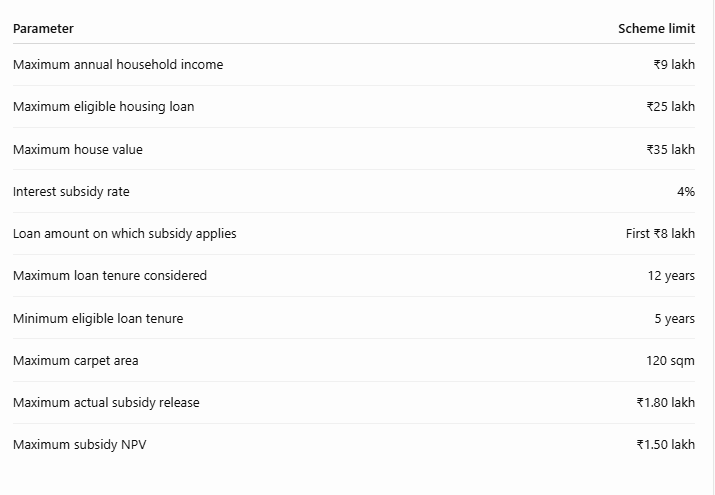
The maximum net present value (NPV) of the subsidy is ₹1.50 lakh, calculated at the scheme’s specified discount rate of 8.5%.
These limits apply to the Interest Subsidy Scheme and should not be confused with the assistance available under the other PMAY-U 2.0 components.
Who can qualify for the interest subsidy?
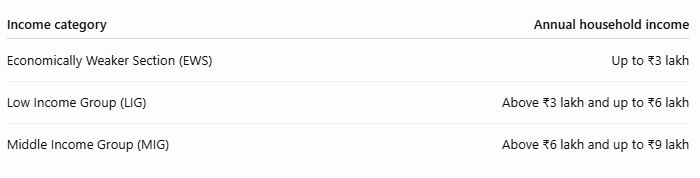
Above ₹6 lakh and up to ₹9 lakh
Applicants must also satisfy the scheme’s housing ownership conditions.
The beneficiary family should not own a pucca house anywhere in India, except the house being acquired or constructed under the applicable provisions. Applicants must also declare that they have not availed benefits under a government housing scheme during the preceding 20 years.
The beneficiary family generally comprises the husband, wife and unmarried sons and daughters. Applicants must provide the required family details and declarations during registration.
Meeting the income requirement alone does not guarantee approval. The property, loan, ownership and other scheme conditions must also be verified.
How does the 4% interest subsidy work?
The scheme provides a 4% interest subsidy on the first ₹8 lakh of an eligible housing loan for a tenure of up to 12 years.
This is an important distinction: the subsidy is not calculated on the entire housing loan.
For example, consider a household taking a housing loan of ₹20 lakh. If the household and property satisfy the scheme conditions, the loan may qualify for the subsidy. However, the 4% subsidy calculation applies only to the first ₹8 lakh, not the entire ₹20 lakh.
The maximum actual subsidy release is ₹1.80 lakh. The amount received depends on the eligible loan amount and tenure.
A loan below ₹8 lakh or a tenure shorter than 12 years can result in a proportionately lower subsidy. The minimum eligible loan tenure is five years.
How is the subsidy credited to the home loan?
The subsidy is released in five equal yearly instalments through Direct Benefit Transfer (DBT) into the beneficiary’s home loan account.
The participating Primary Lending Institution (PLI) credits the subsidy towards the outstanding principal. This reduces the principal balance on which the borrower continues to pay interest.
However, subsequent releases are conditional.
The loan account must remain active and standard when the subsidy is released. More than 50% of the principal must also remain outstanding.
If the loan account becomes a non-performing asset (NPA), or the outstanding principal falls below the prescribed threshold, the subsidy may not be released.
This means borrowers should not treat the maximum ₹1.80 lakh as an unconditional upfront payment.
What types of properties are eligible?
The Interest Subsidy Scheme also places limits on the property being purchased or constructed.
The maximum permitted house value is ₹35 lakh, while the maximum carpet area is 120 square metres.
The eligible housing loan cannot exceed ₹25 lakh.
These limits apply to metro and non-metro locations, according to the official scheme FAQ.
The scheme can cover the purchase, repurchase or construction of a qualifying residential property. However, a loan taken only to purchase a plot of land does not qualify for the interest subsidy.
Applicants planning to construct a house on land they already own may be eligible, subject to the scheme’s property and documentation requirements.
Which housing loans qualify under PMAY-U 2.0?
The loan must be sanctioned and disbursed on or after September 1, 2024.
A loan sanctioned before this date does not become eligible simply because it is revised or modified after the cutoff date.
The loan must be obtained from a participating Primary Lending Institution (PLI). These are financial institutions that extend housing loans and participate in the PMAY-U 2.0 implementation framework.
Applicants should confirm their lender’s participation and the loan’s eligibility before assuming that the subsidy will be available.
The scheme also provides that eligible beneficiaries should not be charged a processing fee by participating lending institutions for housing loans up to the eligible loan amount under the scheme.
How to apply for the PMAY-U 2.0 interest subsidy
Applicants interested in receiving the benefit must register their demand through the official PMAY-U 2.0 Unified Web Portal and provide details of their housing loan and participating lending institution.
The general process is:
Visit the official PMAY-U 2.0 portal.
Read the Interest Subsidy Scheme eligibility conditions.
Register the household and provide the required personal and family information.
Enter the relevant housing loan and Primary Lending Institution details.
Submit the required declarations and supporting documents.
The application is forwarded to the concerned lending institution for due diligence and further processing.
Track the application and subsidy status through the official portal.
The lending institution and concerned authorities verify the applicant’s eligibility before the subsidy claim is processed.
Applicants should retain their application ID and registered mobile number to check the status of registration, verification, approval and subsidy release.
Documents and information applicants may need
The precise document checklist can vary depending on the lending institution and the applicant’s circumstances.
Applicants should be prepared to provide:
Aadhaar and other accepted identity details.
Household and family-member information.
Income self-certificate or affidavit.
Bank account details.
Declaration regarding pucca house ownership.
Declaration regarding benefits received under previous government housing schemes.
Housing loan account and lender details.
Property documents and approved layout information, wherever applicable.
The participating lender may request additional documents to verify the loan and property.
Applicants should follow the checklist provided through the official portal and their lending institution.
When can an applicant be denied the subsidy?
An applicant may fail to qualify even after meeting the income requirement.
Some important exclusion conditions include:
Annual household income exceeding ₹9 lakh.
Housing loan exceeding ₹25 lakh.
Property value exceeding ₹35 lakh.
Carpet area exceeding 120 square metres.
Failure to satisfy the housing ownership and previous-scheme benefit declarations.
A housing loan sanctioned before September 1, 2024.
A loan account that does not meet the prescribed conditions at the time of subsidy release.
The subsidy is also available only once for a property. A subsequent purchaser cannot claim the same benefit again on a property that has already received the subsidy.
A borrower who transfers an existing housing loan from one lending institution to another through a balance transfer cannot claim the subsidy again. Applicants should check the official rules before changing lenders.
What does the scheme mean for India’s affordable housing market?
The Interest Subsidy Scheme adds a housing-finance dimension to India’s urban affordable housing policy.
While construction-focused programmes support the creation of affordable housing stock, interest subsidies address the financing burden faced by eligible households.
The benefit may improve affordability for families purchasing or constructing homes within the prescribed property-value and loan limits. It also encourages eligible households to access formal housing finance through participating institutions.
However, the scheme’s impact will depend on awareness, lender participation, verification procedures and the availability of homes within the prescribed price and carpet-area limits.
For prospective buyers, the most important consideration is to assess the total cost of homeownership rather than focusing only on the subsidy. Down payment requirements, interest rates, maintenance charges, registration costs and long-term repayment capacity remain important parts of the decision.
Frequently asked questions
- What is the maximum subsidy under PMAY-U 2.0?
The maximum actual interest subsidy release under the Interest Subsidy Scheme is ₹1.80 lakh. The maximum net present value is ₹1.50 lakh.
- Is the 4% subsidy applicable to the entire housing loan?
No. The 4% subsidy applies only to the first ₹8 lakh of the qualifying housing loan. A loan can be as high as ₹25 lakh, but the subsidy is not calculated on the amount above ₹8 lakh.
- Can a household earning ₹8 lakh annually apply?
Yes. An eligible household earning ₹8 lakh annually falls within the MIG income category. It must also satisfy the loan, property, ownership and other scheme conditions.
- Is a loan tenure of less than 12 years eligible?
Yes. The minimum eligible loan tenure is five years. However, the subsidy may be reduced proportionately when the tenure is shorter than 12 years.
- Is the subsidy paid directly to the borrower’s bank account?
The subsidy is released through DBT into the beneficiary’s home loan account. It is credited towards the outstanding principal through the participating lending institution.
- Can a borrower receive the subsidy for purchasing a plot?
No. A loan taken only for purchasing land is not eligible. The scheme covers qualifying loans for purchasing, repurchasing or constructing a residential house.
- Can an existing home loan qualify?
Only loans sanctioned and disbursed on or after September 1, 2024, are covered. Loans sanctioned before the cutoff date do not qualify merely because they are revised later.
- Where can applicants check the official eligibility conditions?
Applicants can visit the PMAY-U 2.0 Unified Web Portal at https://pmaymis.gov.in/pmaymis2_2024/ and consult the Interest Subsidy Scheme section.
Conclusion
PMAY-U 2.0’s Interest Subsidy Scheme provides a targeted financial benefit to eligible urban households seeking to purchase or construct a home through housing finance.
The 4% subsidy on the first ₹8 lakh, with a maximum actual release of ₹1.80 lakh, can reduce the outstanding principal on a qualifying housing loan. However, the benefit is subject to strict income, loan, property and repayment conditions.
For homebuyers, checking eligibility before finalising a property or housing loan is essential. The official PMAY-U 2.0 portal and participating lending institution should be treated as the primary sources for application and approval information.
Disclaimer: This article is for general informational purposes and does not constitute financial or housing-loan advice. Eligibility, subsidy release and application approval are subject to official PMAY-U 2.0 guidelines and verification by the concerned authorities and lending institutions.








No Comment! Be the first one.