






India’s First Undersea Rail Tunnel Gains Pace as Second TBM Begins Excavation Beneath Thane Creek
India’s first undersea railway tunnel has reached another major construction milestone with the deployment of a second Tunnel Boring Machine (TBM) beneath Thane Creek for the Mumbai Ahmedabad...

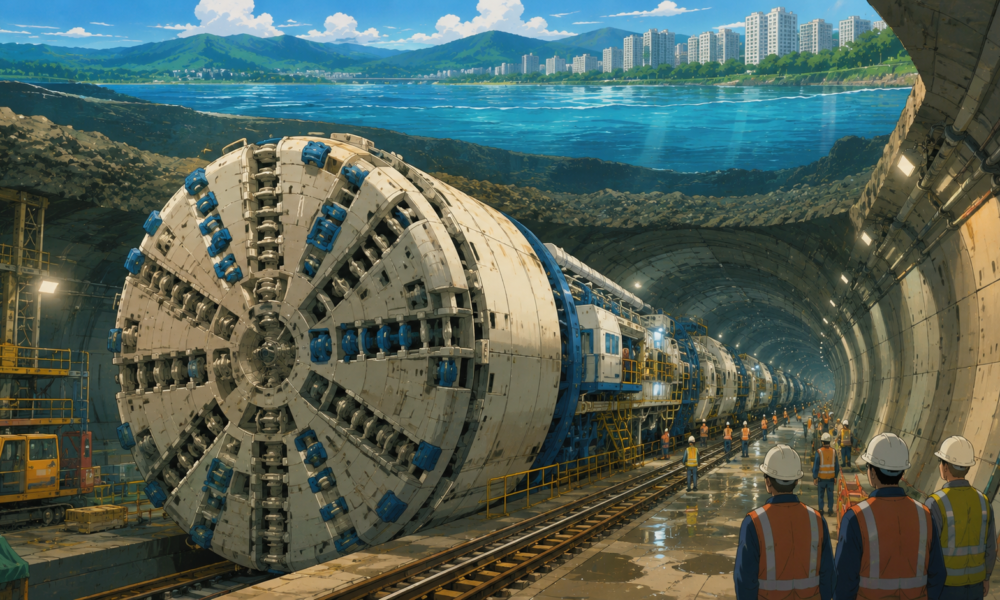
India’s first undersea railway tunnel has reached another major construction milestone with the deployment of a second Tunnel Boring Machine (TBM) beneath Thane Creek for the Mumbai Ahmedabad High Speed Rail Corridor. The development marks significant progress on one of the country’s most technically complex infrastructure projects, bringing the nation’s first bullet train closer to reality.
The newly launched TBM has started its journey from the Sawli shaft in Ghansoli towards Vikhroli, excavating a section of the 21 kilometre underground corridor that will eventually connect Bandra Kurla Complex with Shilphata. Of this underground stretch, around 7 kilometres will pass beneath Thane Creek, making it India’s first railway tunnel constructed below the seabed.
The Mumbai Ahmedabad High Speed Rail project is India’s flagship bullet train programme and is being implemented by the National High Speed Rail Corporation Limited. While elevated viaducts make up most of the route, the underground Mumbai section presents unique engineering challenges due to dense urban development, soft ground conditions and the need to minimise disruption at the surface.
The second TBM joins another machine that began tunnelling earlier this month from Vikhroli towards Bandra Kurla Complex. With excavation now progressing simultaneously from both directions, construction is expected to advance at a faster pace while maintaining high safety standards.
The newly deployed machine is among the largest tunnel boring machines ever used for railway construction in India. Equipped with a 13.6 metre cutter head and weighing approximately 3,200 tonnes, the Mixshield slurry TBM has been specially designed to handle challenging geological conditions beneath Thane Creek. The technology uses pressurised bentonite slurry to stabilise the tunnel face during excavation, reducing settlement and protecting surrounding infrastructure.
Engineers have also incorporated advanced monitoring and safety systems throughout the tunnelling operation. The machine continuously monitors gases including methane and carbon monoxide while automated fire protection systems, emergency refuge chambers and real time ground movement monitoring help maintain safe working conditions for construction teams.
Beyond its engineering significance, the tunnel represents a major leap in India’s capability to execute complex underground transport infrastructure. The project is expected to strengthen domestic expertise in advanced tunnelling technologies while creating opportunities for construction equipment manufacturers, engineering consultants, specialised contractors and skilled workforce development.
The bullet train corridor is also expected to improve regional connectivity between Maharashtra and Gujarat by significantly reducing travel times and supporting economic activity along one of India’s busiest industrial corridors. Faster passenger movement, improved business connectivity and technology transfer from global partners are expected to generate long term benefits for the country’s transport sector.
The project complements wider investments in high speed rail, metro systems, dedicated freight corridors and multimodal transport infrastructure under the PM Gati Shakti National Master Plan. As tunnelling work progresses beneath Thane Creek, the Mumbai Ahmedabad Bullet Train project continues to demonstrate how advanced engineering and modern construction technologies are reshaping India’s infrastructure landscape.
With two tunnel boring machines now operating simultaneously, India’s first undersea railway tunnel has entered one of its most important construction phases, bringing the country’s high speed rail ambitions another step closer to completion.





No Comment! Be the first one.