





What If India’s Flyovers Became Public Spaces Instead of Dead Zones?
If a city’s flyovers leave large amounts of empty space around them, one project in Mumbai has found an interesting way to put that space to use. One Green Mile is a 200-metre-long public space...

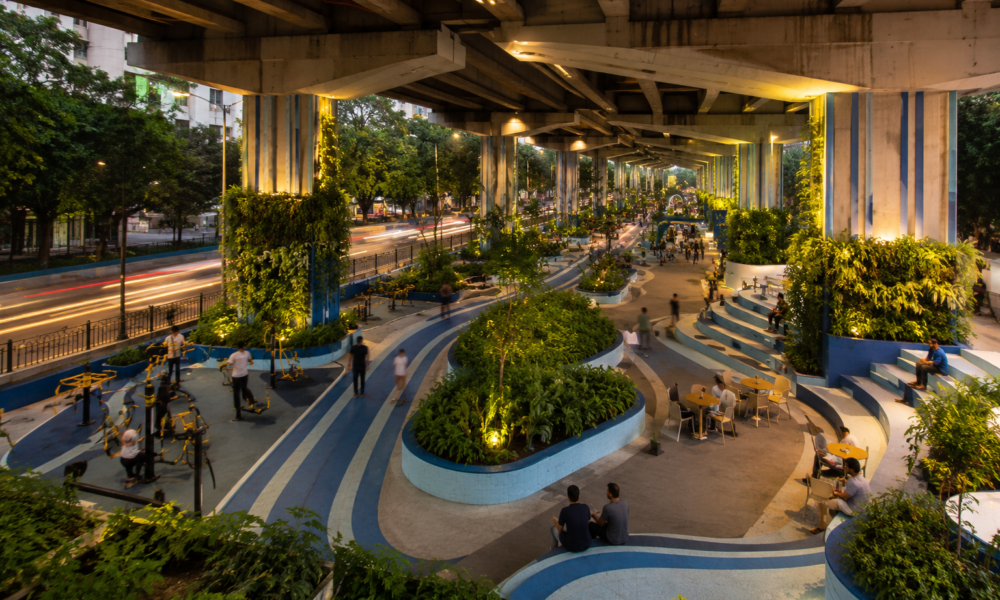
If a city’s flyovers leave large amounts of empty space around them, one project in Mumbai has found an interesting way to put that space to use. One Green Mile is a 200-metre-long public space designed by MVRDV in collaboration with Mumbai-based StudioPOD. The project transformed an unused area beneath the Senapati Bapat Marg flyover into a vibrant public space for the local community.
The project focuses on a 200-metre-long stretch beneath the flyover at Parel Baug. The area previously had very few facilities for local residents and was largely underused. Instead of allowing the space beneath the flyover to remain empty, the designers turned it into an area that could benefit the wider community.
The space now features greenery, comfortable seating areas, walking paths and public facilities. It also includes a gym, reading area, live performance spaces and shaded seating. Blue lines and bright colours run throughout the space, giving the project a distinct visual identity. The designers have also created different levels and gently sloping sections to make the area more dynamic and engaging.
Plants have been added throughout the space, including planters, green walls and planted screens. The greenery helps cool the area, reduce noise and support biodiversity, while also making the space more comfortable for pedestrians and cyclists.
The project also includes several facilities designed to improve movement and accessibility, such as cycle paths, large pedestrian crossings, better lighting and a mobility hub. One of its most interesting features is its rainwater management system. Rainwater collected during Mumbai’s monsoon is stored and filtered before being used to water the plants.
The project follows the principles of a circular economy, giving existing infrastructure a new purpose instead of requiring the construction of an entirely new space.
Above, the flyover continues to carry heavy traffic. Below, however, the space has been transformed into a calmer environment where people can walk, sit, exercise, read and relax.
And this could be just the beginning. The wider One Green Mile plan aims to improve around 1.8 kilometres of streets and transport infrastructure along Senapati Bapat Marg. The broader road corridor stretches for around 11.22 km, from the Mahalaxmi Racecourse to the Dharavi Mangrove Region.
The bigger idea is that the spaces beneath flyovers, metro lines and elevated roads do not have to remain empty, neglected or unattractive.
Instead, they could become parks, walking areas, cycle routes, community spaces and other public facilities. One Green Mile shows how urban design can work with existing concrete infrastructure to create spaces that are not only functional, but also useful and welcoming for people.






No Comment! Be the first one.