








India Accelerates Infrastructure Push with ₹12.22 Lakh Crore Capex Outlay in FY27
India has reinforced its infrastructure-led growth strategy by raising public capital expenditure to ₹12.22 lakh crore in the Union Budget for FY2026-27, marking an 11.5 per cent increase over the...

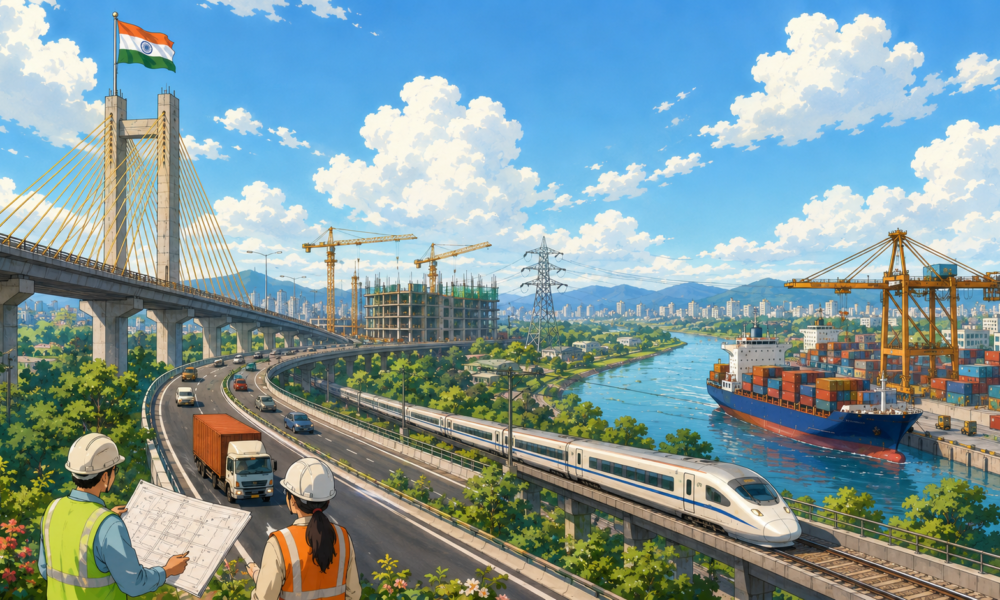
India has reinforced its infrastructure-led growth strategy by raising public capital expenditure to ₹12.22 lakh crore in the Union Budget for FY2026-27, marking an 11.5 per cent increase over the revised estimate for the previous fiscal. The move underscores the government’s intent to leverage infrastructure investment as a catalyst for economic expansion and job creation.
The enhanced capital expenditure forms a central pillar of the country’s long-term development blueprint and aligns with the vision of transforming India into a developed economy by 2047. Total government expenditure for FY27 is estimated at ₹53.47 lakh crore, with infrastructure continuing to command a substantial share of public spending.
Roads and highways remain a key focus area under the investment programme. The Ministry of Road Transport and Highways has received an allocation of ₹3.09 lakh crore for FY27, representing a 7.9 per cent increase over the revised estimate for FY26. The additional funding is expected to support the construction of new expressways, improve logistics corridors and strengthen last-mile connectivity across regions.
India’s port and maritime ecosystem is also witnessing sustained momentum under the Sagarmala Programme. As of March 2026, 78 projects worth ₹5,356.75 crore had been completed under the initiative. The programme has prioritised port modernisation, industrial integration and the creation of coastal economic zones to improve trade efficiency and generate employment opportunities in maritime regions.
Inland waterways are emerging as another important component of India’s multimodal transport architecture. The number of National Waterways has expanded from just five in 2014 to 111 in 2026, collectively spanning more than 20,000 kilometres across states and union territories. Of these, 32 waterways are currently operational, contributing to a significant increase in cargo movement and encouraging a shift towards more sustainable modes of transportation.
The government’s infrastructure strategy is increasingly centred on multimodal integration, with investments extending beyond conventional transport assets to encompass logistics parks, industrial corridors, digital infrastructure and urban development projects. Policymakers believe that enhanced connectivity can reduce logistics costs, improve supply chain efficiency and elevate India’s global competitiveness.
Recent economic indicators also point towards resilience in the infrastructure sector. Infrastructure output in India continued its expansion trajectory in May 2026, supported by higher electricity generation and robust production of key construction materials such as steel and cement. The sustained growth highlights the sector’s capacity to absorb increased public investment and support broader economic activity.
Industry analysts have noted that the government’s continued emphasis on infrastructure development could stimulate private-sector participation across sectors, including transport, energy, logistics and urban infrastructure. Greater public spending is also expected to create multiplier effects by attracting institutional capital and accelerating project execution across states.
With infrastructure spending maintaining its position at the heart of public policy, India is steadily constructing the foundations of a more integrated, efficient and investment-ready economy. The latest capex push signals a determined effort to strengthen connectivity networks and create enduring economic assets capable of supporting the country’s long-term growth ambitions.






No Comment! Be the first one.