






Obama Presidential Centre opens in Chicago, blending civic architecture with community-focused design
The Obama Presidential Centre has opened in Chicago’s Jackson Park, marking the debut of one of the most closely watched civic architecture projects in the United States in recent years. Spread...

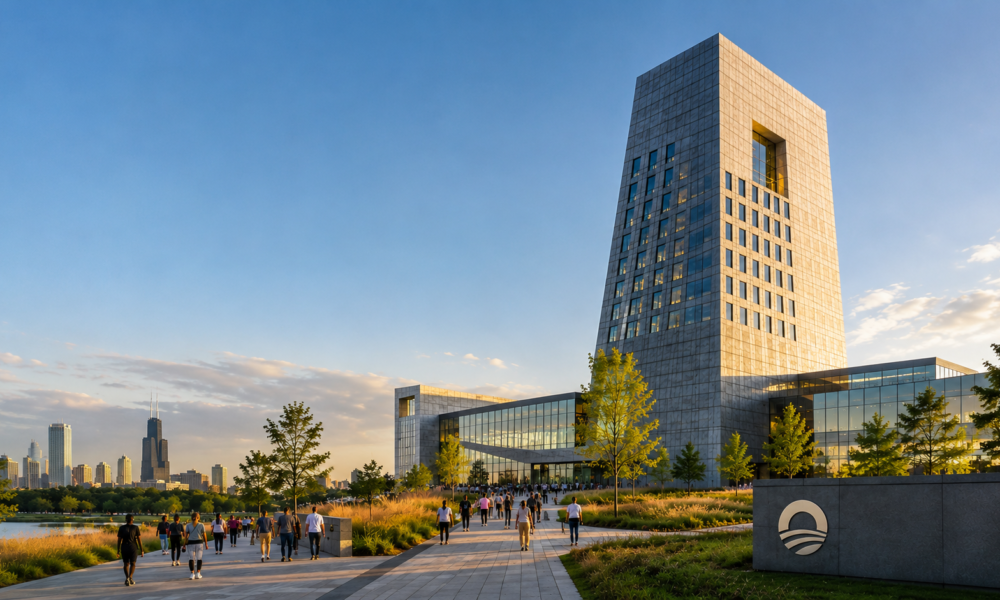
The Obama Presidential Centre has opened in Chicago’s Jackson Park, marking the debut of one of the most closely watched civic architecture projects in the United States in recent years. Spread across a 19.3-acre campus on the South Side, the centre has been designed not as a conventional presidential library, but as a broader public-facing cultural and civic complex intended to anchor community engagement, education and public programming.
Designed by Tod Williams Billie Tsien Architects in collaboration with landscape architects Michael Van Valkenburgh Associates, the campus includes an eight-storey museum tower, a public library branch, a forum building for performances and events, and an athletic centre. According to Architectural Digest, the project has been conceived to encourage openness and accessibility, with multiple pedestrian entry points and landscaped pathways that connect the campus with the surrounding parkland rather than isolating it as a standalone monument.
The centre’s opening is significant not only because of its political and cultural symbolism, but also because it reflects a wider shift in how large public institutions are being imagined through architecture. Instead of emphasising legacy through formality and monumentality alone, the Obama Presidential Center appears to position civic architecture as an active social space, one that invites neighbourhood participation and public use. That design philosophy is visible in the campus plan, which integrates exhibition spaces, community gathering areas, educational infrastructure and outdoor landscapes into a single urban precinct.
At the core of the campus is the museum tower, which houses exhibits tracing the lives and political journey of Barack Obama and Michelle Obama, including material from the 2008 presidential campaign and the years of the Obama administration. The centre also includes a branch of the Chicago Public Library, featuring books selected by Obama, as well as a forum designed to host performances, public discussions and educational activities. A 60,000-square-foot athletic centre expands the project beyond the boundaries of a museum or archive, reinforcing its positioning as a mixed-use community institution rather than a purely commemorative one.
Architecturally, the project has been described as a porous campus rather than a single iconic object. That distinction matters in a city like Chicago, where architecture is often judged as much by its urban relationships as by its visual statement. The Jackson Park site, originally shaped by Frederick Law Olmsted and Calvert Vaux, adds another layer of complexity, requiring the new campus to negotiate between contemporary civic ambition and a historically important landscape setting. Architectural Digest noted that the project uses landscape, circulation and public access as core design tools, allowing visitors to enter from multiple sides and move through the campus in a way that feels connected to the surrounding park rather than separated from it.
The opening of the Obama Presidential Center also arrives at a moment when civic and institutional architecture is being asked to do more than simply house collections or memorialise public figures. Across the United States and elsewhere, major cultural projects are increasingly being judged by how well they support community use, public programming and local identity. In that context, the Chicago project is likely to be read not only as a presidential centre, but also as a test case in how architecture can translate political legacy into civic infrastructure.
For Chicago, the project adds another major destination to the city’s architectural landscape while bringing fresh investment and attention to the South Side. For the design world, it offers a prominent example of how contemporary public architecture is shifting toward openness, flexibility and social use. And for observers of global architecture and urban development, the Obama Presidential Center stands as a reminder that some of the most consequential buildings today are not necessarily the tallest or most technologically ambitious, but the ones trying to redefine what public space, memory and community can look like in built form.






No Comment! Be the first one.