








India’s PLI Schemes Attract ₹2.4 Lakh Crore Investment as Manufacturing Push Gains Pace
India’s Production Linked Incentive (PLI) schemes continue to strengthen the country’s industrial infrastructure, with cumulative investments crossing ₹2.40 lakh crore and exports...

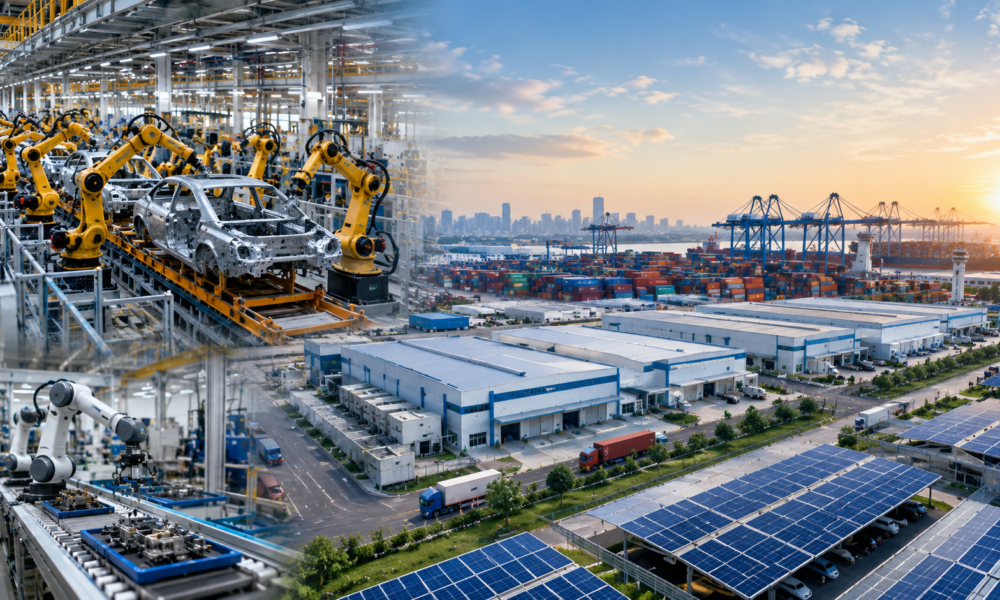
India’s Production Linked Incentive (PLI) schemes continue to strengthen the country’s industrial infrastructure, with cumulative investments crossing ₹2.40 lakh crore and exports exceeding ₹15.2 lakh crore across key manufacturing sectors. The latest figures highlight the growing role of policy-driven investments in expanding factories, supply chains and industrial capacity across the country.
Introduced to boost domestic manufacturing and reduce dependence on imports, the PLI programme covers sectors including electronics, pharmaceuticals, telecom equipment, automobiles, batteries, food processing, textiles, drones and solar modules. The scheme encourages companies to expand production in India by offering financial incentives linked to incremental sales and manufacturing output.
The investment surge has supported the development of new manufacturing facilities, logistics infrastructure and industrial ecosystems across several states. Companies have expanded production units, created supplier networks and increased local sourcing, helping strengthen India’s position as a global manufacturing destination. As more facilities become operational, supporting infrastructure such as roads, power supply, warehousing and transport networks is also witnessing higher demand.
One of the biggest success stories has been electronics manufacturing. India has significantly increased mobile phone production over the past few years, with global manufacturers expanding operations and using the country as an export base. Similar momentum is now being seen in sectors such as advanced chemistry cell batteries, solar photovoltaic modules and electric vehicles, all of which require large-scale industrial infrastructure and reliable supply chains.
The infrastructure impact of the PLI programme extends beyond factory buildings. Industrial corridors, logistics parks, multimodal transport facilities and port connectivity are becoming increasingly important as manufacturers scale up production. State governments are also competing to attract investments by developing industrial parks, improving ease of doing business and upgrading supporting infrastructure.
Employment generation remains another important outcome of the programme. New manufacturing facilities require skilled workers, engineers, logistics providers and service businesses, creating opportunities across both urban and semi-urban regions. The expansion of supplier ecosystems is also supporting thousands of micro, small and medium enterprises that provide components and services to larger manufacturers.
Industry experts believe the next phase of growth will depend on continued investment in transport, power and digital infrastructure. Faster freight movement, reliable electricity, improved port capacity and modern warehousing will be essential to help Indian manufacturers remain globally competitive. As production volumes increase, infrastructure quality will play a bigger role in reducing costs and improving export efficiency.
The progress of the PLI schemes also reflects a broader shift in India’s infrastructure strategy. Instead of focusing only on highways, railways and airports, the country is increasingly investing in industrial infrastructure that supports manufacturing and exports. This integrated approach is expected to strengthen supply chains, attract more private investment and improve India’s competitiveness in global markets over the coming years.








No Comment! Be the first one.