








Ghaziabad-New Moradabad Railway Corridor to Get Third and Fourth Lines
Ghaziabad: The railway network between Ghaziabad and New Moradabad is set for a major capacity expansion with the construction of third and fourth railway lines. Northern Railway has started the...

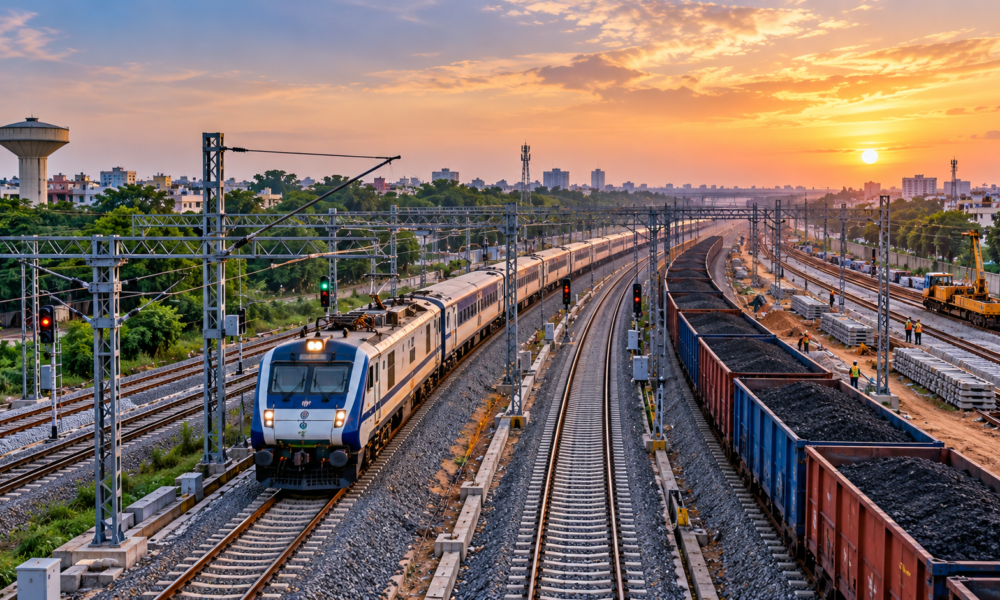
Ghaziabad: The railway network between Ghaziabad and New Moradabad is set for a major capacity expansion with the construction of third and fourth railway lines.
Northern Railway has started the bidding process for a ₹3,726.34 crore Engineering, Procurement and Construction contract for the project. The bidding process began on September 28, 2026, and is scheduled to remain open until February 23, 2027.
The project is part of a larger Ghaziabad-Sitapur third and fourth line expansion approved by the Union Cabinet earlier this year.
The larger project covers about 403 km and has an estimated cost of ₹14,926 crore.
The railway corridor is important because it is part of a high-density route connecting northern India with other parts of the country.
At present, the Ghaziabad-New Moradabad section is operating under heavy pressure. The corridor is reported to be running at around 168% of its capacity.
Adding two more tracks can provide railway authorities with additional space to operate trains.
The project is not simply about laying new tracks.
It includes civil engineering work, signalling, telecommunications, electrification and other systems needed to integrate the new lines with the existing railway network.
The additional capacity is expected to support both passenger and freight trains.
Freight movement is particularly important because the route carries commodities such as coal, foodgrains, fertilisers and steel. The upgraded corridor is expected to support around 35.72 million tonnes of freight annually.
For passengers, additional tracks can improve operational flexibility. Trains can be scheduled more efficiently when passenger and freight services have more room to operate.
For freight operators, better rail capacity can also improve logistics.
Railways play a major role in India’s supply chain because large quantities of goods can be transported over long distances more efficiently than by road.
The expansion also has a regional importance for Ghaziabad and western Uttar Pradesh.
Ghaziabad is closely connected with Delhi-NCR and is an important industrial and residential centre. Better railway infrastructure can strengthen its connection with Moradabad and other cities along the corridor.
The project also fits into India’s wider railway expansion programme.
The government has been increasing spending on railway infrastructure, while electrification, signalling, station redevelopment and track expansion are being carried out across the network.
Official data shows that India’s national railway budget has increased substantially over the past decade, while railway electrification has reached almost the entire broad-gauge network.
The Ghaziabad-New Moradabad project therefore represents a less visible but important part of India’s infrastructure expansion.
New trains attract attention, but additional tracks, signalling and electrification determine how many trains the network can actually handle.
As construction moves forward, the project will be closely watched by passengers, freight operators and industries that depend on this major northern railway route.









No Comment! Be the first one.