







Earthquake Risk in India: Are Indian Cities Prepared for a Major Seismic Event?
Earthquakes are not simply a natural hazard for India. They are also an infrastructure challenge. With rapid urbanisation, high-density construction and millions of people living in major cities, the...

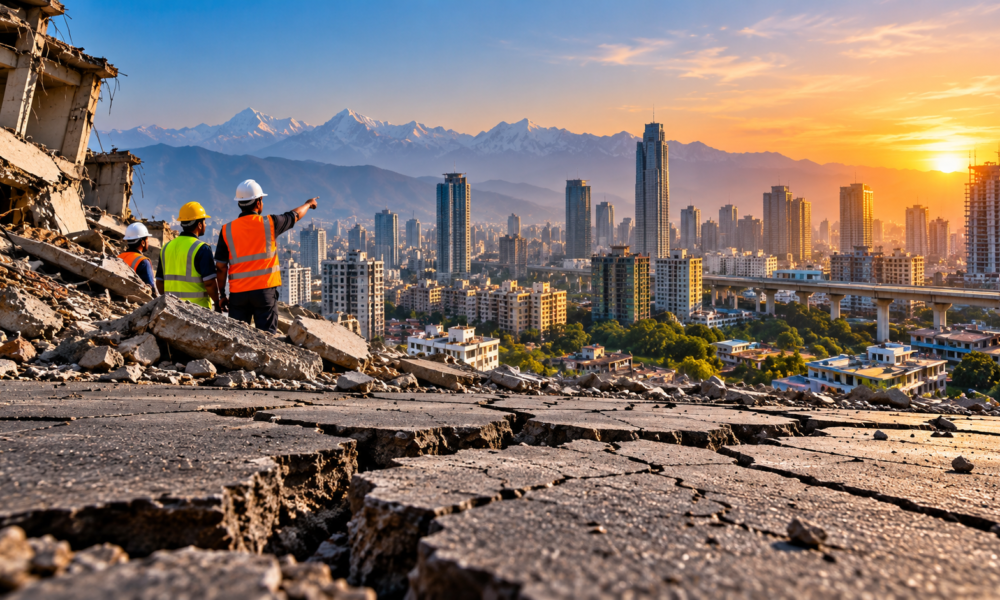
Earthquakes are not simply a natural hazard for India. They are also an infrastructure challenge.
With rapid urbanisation, high-density construction and millions of people living in major cities, the impact of a major earthquake could extend far beyond damaged buildings.
India’s seismic risk is already significant.
According to the National Institute of Disaster Management, around 59% of India’s landmass falls within earthquake-prone zones. This includes 11% in very high-risk Zone V, 18% in high-risk Zone IV and 30% in moderate-risk Zone III.
Several major cities are located in these areas. Delhi falls in Zone IV, while Guwahati and Srinagar are in Zone V. Mumbai, Kolkata and Chennai fall within Zone III.
Why Urban Infrastructure Matters
The severity of an earthquake does not depend only on its magnitude.
Building quality, construction practices, land use, emergency access and the resilience of critical infrastructure can determine how severe the consequences become.
A densely populated city with poorly maintained buildings and narrow emergency routes can face significantly greater disruption.
Hospitals, electricity networks, water pipelines, bridges, roads and telecommunications systems can also be affected.
This means earthquake preparedness needs to extend beyond individual buildings.
Structural Safety Is Becoming a Policy Priority
The government published a national framework for structural safety audits and seismic resilience in July 2026.
The framework highlights the importance of structural safety audits and seismic resilience, while the Model Building Bye-Laws include provisions covering structural safety and seismic resilience.
The challenge, however, is implementation.
Building regulations only improve resilience when they are properly followed, inspected and enforced.
Existing buildings present another problem.
Large numbers of older structures were built before current seismic standards became widely applied. Retrofitting these buildings can be technically complicated and expensive.
The Retrofitting Challenge
Retrofitting can involve strengthening columns, beams, foundations and walls or improving connections between structural components.
For public infrastructure, the stakes are particularly high.
Hospitals, schools, railway stations, bridges and emergency facilities need to remain operational during disasters because they become critical response centres immediately after an earthquake.
That makes resilience investment different from conventional infrastructure spending.
The objective is not simply to construct new assets. It is to ensure that existing assets can continue functioning under extreme conditions.
Cities Need Better Preparedness
Urban planning also plays an important role.
Emergency response can become difficult when buildings are constructed without adequate setbacks, access roads are narrow or critical infrastructure is concentrated in vulnerable locations.
Earthquake preparedness therefore requires coordination between urban planners, engineers, local authorities, developers and emergency agencies.
India’s growing cities cannot afford to treat seismic resilience as a specialist engineering issue alone.
What Comes Next?
The country’s infrastructure expansion presents an opportunity to incorporate resilience into new construction from the beginning.
For existing cities, structural audits, retrofitting, emergency planning and stronger enforcement of building regulations will become increasingly important.
The central question is not whether India can predict the next major earthquake.
It cannot.
The more practical question is whether India’s buildings and infrastructure can withstand one when it arrives.
For a rapidly urbanising country, earthquake resilience is increasingly becoming a core part of infrastructure planning rather than an emergency issue to address after disaster strikes.
Disclaimer: This article is for informational purposes only and does not constitute investment advice.







No Comment! Be the first one.