








India’s Agriculture Infrastructure Challenge: Why Storage and Supply Chains Matter
India’s agricultural economy depends on more than what happens on the farm. The infrastructure connecting farms to markets can determine how much of the value created by farmers ultimately...

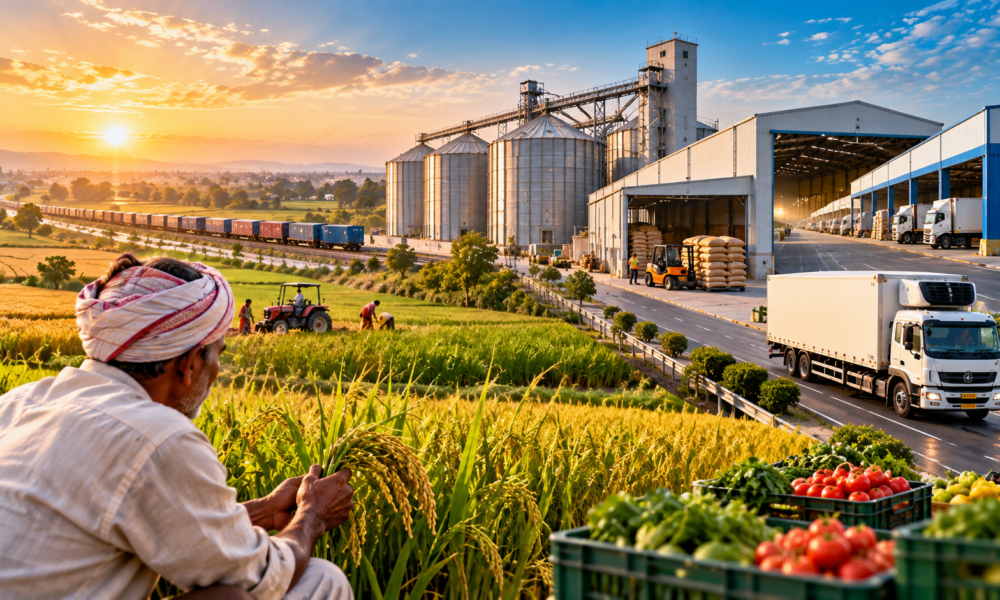
India’s agricultural economy depends on more than what happens on the farm.
The infrastructure connecting farms to markets can determine how much of the value created by farmers ultimately reaches consumers.
Storage facilities, cold chains, warehouses, processing centres, transport networks and agricultural markets are therefore becoming increasingly important to India’s food economy.
The scale of the challenge remains significant.
According to a PRS analysis, India’s cold-storage capacity was estimated at around 39.7 million tonnes in January 2025, compared with an estimated requirement of 61 million tonnes cited by an earlier government committee.
The gap highlights why agriculture infrastructure remains an important investment area.
Why Storage Matters
Agricultural production is seasonal, but consumption takes place throughout the year.
When farmers harvest large quantities simultaneously, inadequate storage can force them to sell quickly.
This can create price pressure and increase post-harvest losses, particularly for perishable products.
Better warehouses and cold-storage facilities can give farmers more flexibility over when and where they sell.
Infrastructure can therefore influence both farm incomes and food prices.
Government Is Expanding Agricultural Infrastructure
The Agriculture Infrastructure Fund was created to support farm-gate storage and logistics infrastructure.
According to PRS, around ₹60,583 crore had been disbursed for approximately 1.43 lakh projects by February 18, 2026.
Projects supported through the fund include warehouses, sorting and grading facilities, primary processing units and cold-storage projects.
The government is also developing decentralised grain-storage infrastructure through its cooperative-sector storage programme.
The programme involves assets such as godowns, processing units and Fair Price Shops at the level of Primary Agricultural Credit Societies and other cooperatives.
The Supply Chain Is the Missing Link
Building storage alone is not enough.
Agricultural infrastructure must function as a connected network.
A farmer may have access to a warehouse, but if roads are poor or transportation costs are high, the infrastructure may not deliver its full economic value.
Similarly, cold storage requires reliable electricity and efficient logistics.
This makes rural roads, rail freight, refrigerated transportation, electricity infrastructure and digital market connections part of the larger agricultural infrastructure ecosystem.
Processing Could Add More Value
India can also benefit from expanding food-processing infrastructure.
Instead of selling agricultural products immediately after harvest, farmers and businesses can increasingly move produce into processing, packaging and value-added products.
This can extend shelf life and potentially create additional economic opportunities in rural areas.
The challenge is ensuring that infrastructure reaches smaller producers rather than remaining concentrated around major agricultural centres.
What Does the Future Hold?
India’s agricultural infrastructure requirements will increase as food demand rises and supply chains become more sophisticated.
Climate variability could make the issue even more important.
Extreme rainfall, heat and drought can disrupt production, making storage and logistics capacity essential for maintaining food availability.
The next stage of agricultural development may therefore depend not only on producing more food, but on building the infrastructure required to store, process and transport it efficiently.
For India, better farm infrastructure could become one of the most important links between agricultural productivity and rural economic growth.
Disclaimer: This article is for informational purposes only and does not constitute investment advice.









No Comment! Be the first one.