







AI Data Centres Are Becoming India’s New Infrastructure Race
Artificial intelligence is creating a new infrastructure race in India. Behind every AI application, cloud service and large language model is a physical network of data centres, servers, power...

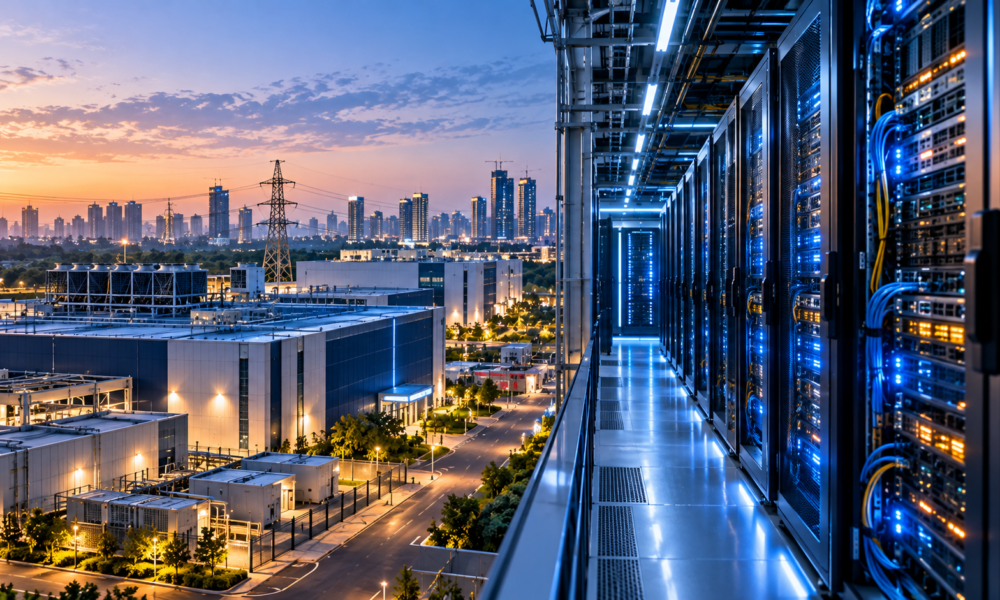
Artificial intelligence is creating a new infrastructure race in India. Behind every AI application, cloud service and large language model is a physical network of data centres, servers, power systems, cooling equipment and high-speed connectivity.
India’s data centre industry has expanded rapidly in recent years. Government data shows that national data centre capacity increased from about 375 MW in 2020 to around 1,500 MW in 2025. Industry research indicates that the expansion is accelerating as cloud computing and AI workloads increase.
Cushman & Wakefield reported that India’s operational data centre capacity reached nearly 1.8 GW in the first half of 2026, with another 3.9 GW in the development pipeline across major markets.
AI is changing the requirements of these facilities. Traditional data centres were built mainly around cloud services, enterprise applications and digital storage. AI workloads require much more computing power, especially for high-performance GPUs, and this creates greater requirements for electricity, cooling and network capacity.
The power requirement is becoming one of the biggest infrastructure challenges. The Ministry of Power has projected an additional 26.3 GW of electricity demand from AI data centres by 2031-32. This means India’s AI expansion cannot be separated from the development of its electricity generation and transmission networks.
Cooling is another major requirement. High-density computing equipment generates significant heat and needs sophisticated cooling systems to operate reliably. Operators are increasingly exploring technologies such as direct-to-chip liquid cooling, adiabatic cooling and immersion cooling to manage energy and water consumption.
Location is also becoming a major infrastructure consideration. Data centres need reliable electricity, fibre connectivity, suitable land, cooling infrastructure and strong network connections. This has helped established hubs such as Mumbai, Chennai, Hyderabad and Delhi NCR attract large-scale development, while other cities are also entering the market.
The growth is also attracting significant investment. Companies across the technology, infrastructure, energy and real-estate sectors are developing new facilities and expanding existing capacity. Large projects are increasingly being planned as hyperscale campuses capable of supporting high-density computing.
India’s AI infrastructure ambitions also include public computing capacity. Under the IndiaAI Mission, more than 38,000 GPUs had been onboarded through 14 empanelled service providers and data centres, according to the Ministry of Electronics and Information Technology.
The infrastructure challenge is therefore broader than simply constructing server buildings. AI data centres require an entire ecosystem of power generation, transmission lines, substations, cooling systems, fibre networks, land, security and specialised equipment.
This is also changing the relationship between digital infrastructure and traditional infrastructure. A new AI data centre can influence local electricity demand, industrial land requirements, fibre deployment and even water-management planning.
For India, the next stage of the AI race may therefore be determined not only by software and computing talent but also by the country’s ability to build physical infrastructure at scale.
The data centre is becoming a new type of critical infrastructure, sitting at the intersection of technology, energy, real estate and telecommunications. As AI adoption grows, India’s infrastructure landscape is likely to see more investment flowing into the physical systems that keep digital services running.




No Comment! Be the first one.