




Chennai Metro Phase II Opens 15-Km Stretch: 11 Stations Connect Poonamallee to Vadapalani
Chennai Metro Phase II Opens 15-Km Stretch: 11 Stations Connect Poonamallee to VadapalaniChennai has added a 15-km stretch to its metro network, connecting Poonamallee Bypass with Vadapalani through...

Chennai Metro Phase II Opens 15-Km Stretch: 11 Stations Connect Poonamallee to Vadapalani
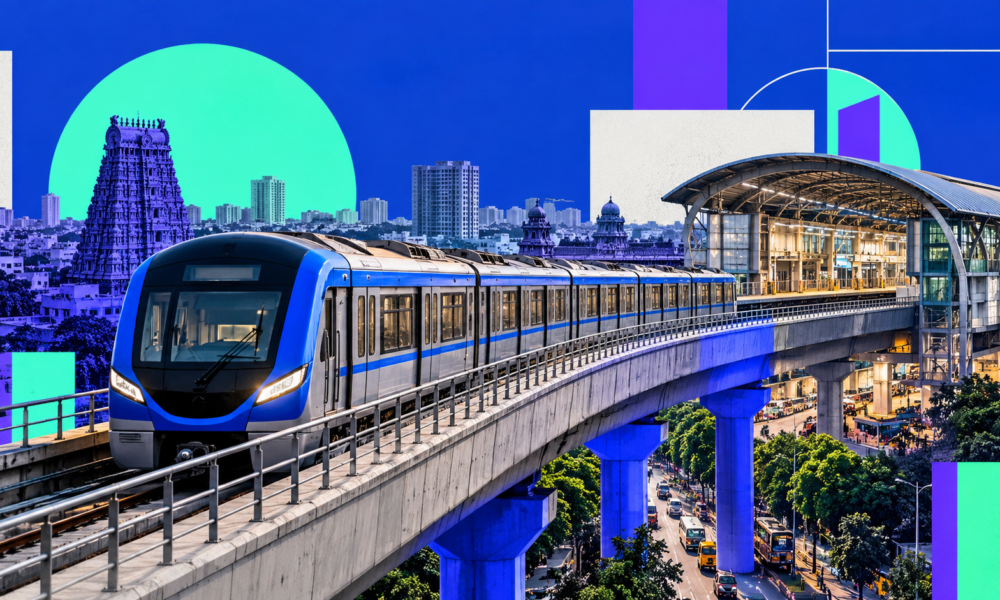
Chennai has added a 15-km stretch to its metro network, connecting Poonamallee Bypass with Vadapalani through 11 stations under the second phase of the Chennai Metro Rail Project. The new elevated section, inaugurated on October 11, 2026, has been developed at an estimated cost of ₹4,900 crore and is expected to improve public transport connectivity across the city’s western suburbs.
The opening marks an important milestone in Chennai’s wider urban mobility expansion, particularly for commuters travelling between Poonamallee, Porur and the existing metro network.
What does the new metro stretch include?
The newly operational section is part of Corridor 4 of Chennai Metro Phase II.
It covers approximately 15 km and includes 11 stations:
- Poonamallee Bypass
- Poonamallee Bus Stand
- Poonamallee Government Hospital
- Karayanchavadi
- Kumananchavadi
- Kattupakkam
- Ayyappanthangal
- Thelliyagaram
- Porur Bypass
- Porur Junction
- Vadapalani
The connection at Vadapalani allows commuters to interchange with existing Phase I metro services.
This is particularly important because it connects western suburban areas with the wider metro network rather than leaving the new stretch as an isolated transport corridor.
Driverless trains and service frequency
The first train on the new section was flagged off at Porur Bypass station during the inauguration.
The corridor has been designed to support advanced metro operations, including driverless train technology.
According to the operational schedule announced at the time of inauguration, trains were planned to operate every 10 minutes during peak hours from Monday to Saturday.
During non-peak hours, the frequency was set at 15 minutes. Sunday and public holiday services were also planned at 15-minute intervals.
The new service is expected to provide an alternative to road transport for people travelling through busy western parts of Chennai.
What about the double-decker section?
One of the notable engineering features of Chennai Metro Phase II is the approximately 3.7-km double-decker section between Porur Junction and Vadapalani.
However, this section was not included in the initial opening. Six stations along the stretch were still awaiting operational readiness at the time of inauguration.
This distinction is important because the inauguration of the first operational stretch does not mean the entire Corridor 4 or the full Phase II network is complete.
Why is Phase II important for Chennai?
Chennai Metro Phase II is planned as a much larger expansion of the city’s public transport network.
The overall network covers approximately 118.9 km across three corridors.
Its objective is to connect more residential areas, commercial centres, industrial locations and transport hubs.
The expansion could help reduce dependence on private vehicles, improve travel predictability and support more efficient movement across the metropolitan region.
Better metro access can also influence commercial development around stations, including retail spaces, offices and residential projects.
What challenges remain?
Metro infrastructure requires substantial capital investment and long-term operational funding.
The success of the expanded network will depend on passenger adoption, station accessibility, integration with buses and suburban railways, and reliable train services.
The remaining Phase II sections must also be completed and commissioned before commuters can experience the full benefits of the planned network.
The bigger picture
Chennai’s new 15-km metro section represents a significant step towards improving urban mobility.
The connection between Poonamallee and Vadapalani brings more western suburban areas into the metro network.
The next challenge is to complete the remaining corridors and create a more integrated public transport system for the city.




No Comment! Be the first one.