







Thoothukudi Port Gets ₹17,167-Crore Outer Harbour Project to Strengthen India’s Maritime Infrastructure
India’s maritime infrastructure is set for a major expansion, with the Union Cabinet approving a ₹17,167-crore Outer Harbour Project at V.O. Chidambaranar Port in Thoothukudi, Tamil Nadu. The...

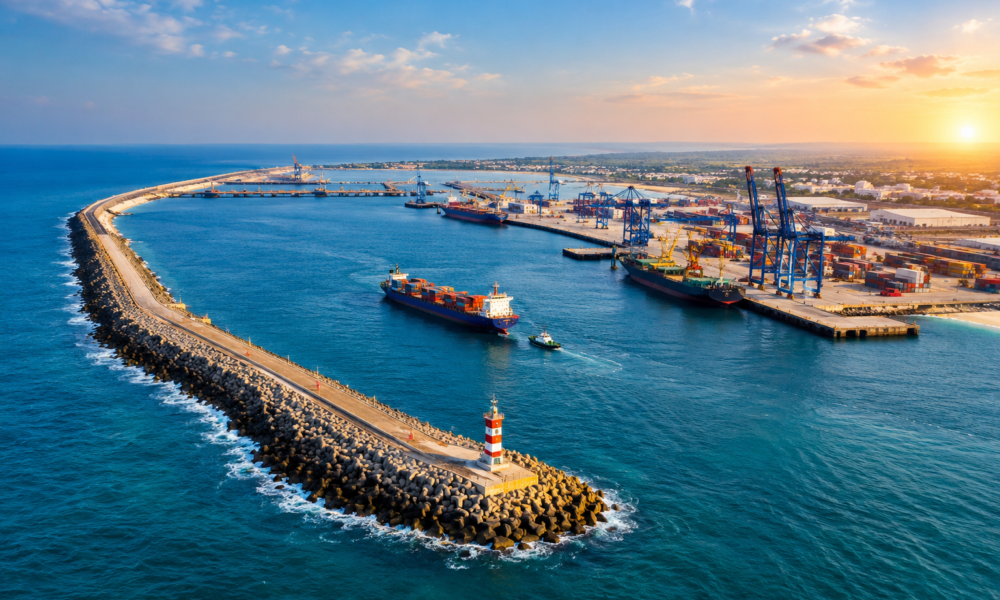
India’s maritime infrastructure is set for a major expansion, with the Union Cabinet approving a ₹17,167-crore Outer Harbour Project at V.O. Chidambaranar Port in Thoothukudi, Tamil Nadu. The project is expected to strengthen the port’s container-handling capacity and improve India’s ability to manage international cargo movement.
The approval marks an important development for Tamil Nadu’s logistics and maritime sectors, particularly as India looks to expand its port infrastructure and strengthen its position in global trade.
What is the Outer Harbour Project?
The proposed Outer Harbour Project will involve an investment of approximately ₹17,167 crore.
According to the approved project structure, ₹11,733 crore will be allocated to harbour infrastructure development under the Hybrid Annuity Model. Another ₹5,434 crore will support container terminal expansion through a Design, Build, Finance, Operate and Transfer model.
The development will include breakwaters, rock bunds, wharfs, backup yard infrastructure and two container terminals.
Each proposed terminal will have approximately 1,000 metres of quay length. Together, the terminals are expected to provide a handling capacity of approximately 4 million to 5.2 million twenty-foot equivalent units (TEUs).
TEU is a standard measurement used by the shipping industry to calculate container-handling capacity.
Why is Thoothukudi important for maritime trade?
V.O. Chidambaranar Port is an important gateway for cargo movement along India’s southeastern coastline.
Its location gives it strategic importance for trade routes connecting India with international markets.
The proposed expansion is expected to improve the port’s ability to handle larger container volumes and support cargo movement across southern India.
Better port infrastructure can also benefit exporters and manufacturers by improving logistics efficiency and reducing the pressure on existing cargo-handling facilities.
Additional investments in green maritime infrastructure
The Outer Harbour Project is part of a broader development push at the port.
In October 2026, eight projects worth approximately ₹753.68 crore were also highlighted for the facility.
These included the conversion of Berth No. 7 into a container terminal with an annual capacity of approximately 4.2 lakh TEUs.
A 3 MW hydrogen station is also planned, while the port has announced a green methanol bunkering facility.
These developments indicate that port modernisation is increasingly connected with cleaner energy and more sustainable maritime operations.
What could it mean for businesses?
An expanded port can support several industries, including manufacturing, logistics, warehousing, shipping and export-oriented businesses.
Higher container-handling capacity could improve cargo movement and strengthen the competitiveness of exporters in Tamil Nadu and neighbouring states.
It may also encourage investment in supporting infrastructure, including road connectivity, freight handling and storage facilities.
However, the benefits will depend on how effectively the additional capacity is used and whether cargo volumes grow alongside infrastructure development.
What challenges remain?
Large harbour projects require extensive construction, dredging, coastal engineering and environmental management.
The project will also require efficient coordination between port authorities, private operators, shipping companies and logistics providers.
The availability of supporting road and rail connectivity will be important to ensure that additional port capacity translates into faster cargo movement.
The bigger picture
The ₹17,167-crore Outer Harbour Project reflects India’s growing focus on maritime infrastructure.
For Thoothukudi, the project could strengthen its position as a major cargo and container-handling centre.
The real test will be whether the expansion improves logistics efficiency, attracts additional cargo and creates a stronger connection between India’s manufacturing sector and international markets.




No Comment! Be the first one.