








Crop Insurance in India: Why Climate Risk Is Becoming an Infrastructure Challenge
India’s agriculture sector is becoming increasingly exposed to unpredictable weather. Floods, droughts, cyclones, hailstorms, unseasonal rainfall and extreme temperatures can disrupt...

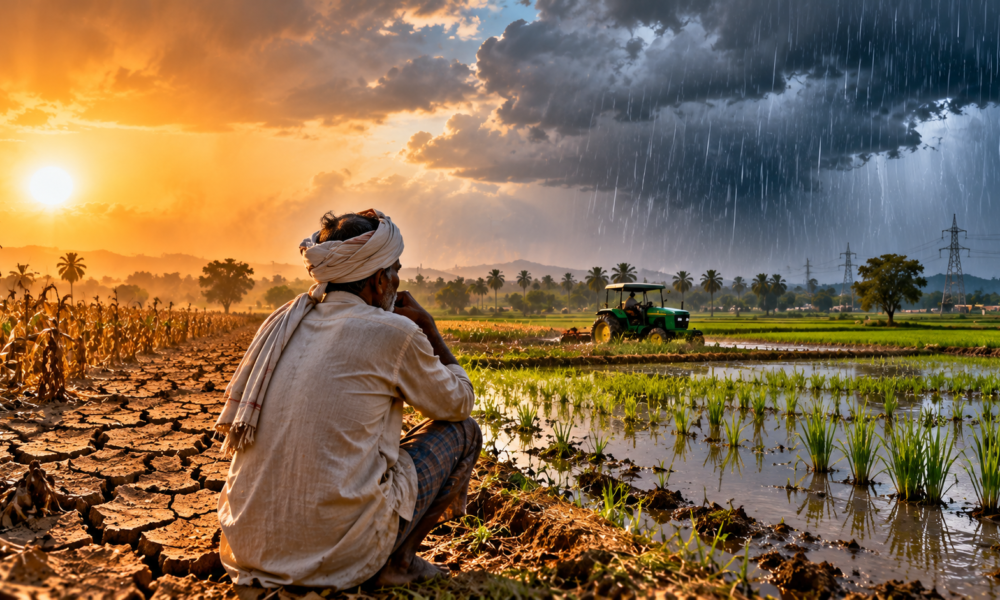
India’s agriculture sector is becoming increasingly exposed to unpredictable weather.
Floods, droughts, cyclones, hailstorms, unseasonal rainfall and extreme temperatures can disrupt agricultural production and threaten farmer incomes.
This makes crop insurance more than a financial product.
It is increasingly part of India’s broader climate-resilience infrastructure.
The Pradhan Mantri Fasal Bima Yojana, or PMFBY, provides insurance coverage against a range of natural risks affecting crops.
For 2026-27, the government has allocated ₹12,200 crore to the scheme. Since its launch in 2016, more than 92.46 crore farmer applications have been insured, while claims exceeding ₹2.06 lakh crore have been paid across more than 26.33 crore farmer applications through Rabi 2025-26.
Climate Risk Is Becoming More Complex
Agricultural risks are no longer limited to predictable seasonal patterns.
Heavy rainfall can cause flooding, while prolonged dry periods can damage crops.
Unseasonal rain can affect crops close to harvest, creating losses even after months of cultivation.
This makes risk management increasingly important.
Insurance can provide financial support after a loss, but resilience also requires physical infrastructure that reduces the probability and severity of damage.
Infrastructure and Insurance Work Together
Flood-control systems, irrigation networks, reservoirs, drainage systems, weather-monitoring stations and rural roads can all reduce agricultural vulnerability.
For example, better irrigation can reduce dependence on rainfall during dry periods.
Improved drainage can reduce the impact of waterlogging.
Better rural roads can help farmers move harvested crops to markets before quality deteriorates.
Insurance therefore works best when combined with infrastructure investment.
Technology Is Changing Crop Insurance
Technology is also becoming an important component of India’s crop-insurance system.
The government says PMFBY has integrated initiatives including the Yield Estimation System based on Technology, or YES-TECH, and the Weather Information Network and Data System, or WINDS.
These systems are intended to improve the speed, accuracy and transparency of claim assessment and settlement.
The scheme also covers risks including inundation, drought, floods, cyclones, hailstorms, unseasonal rainfall and specified post-harvest losses.
The Bigger Rural Infrastructure Challenge
India’s climate resilience challenge extends beyond individual farms.
Agricultural regions need integrated systems that connect irrigation, water management, roads, storage, electricity, weather monitoring and market infrastructure.
Such investment can reduce losses before insurance claims are even required.
This could become increasingly important as extreme weather events place additional pressure on rural economies.
What Does This Mean for India?
Crop insurance provides an important financial safety net, but insurance alone cannot protect agricultural livelihoods.
India’s next phase of agricultural infrastructure development will need to focus increasingly on resilience.
That means building systems capable of managing excess water, conserving water during droughts, maintaining farm-to-market connectivity and improving the quality of climate information available to farmers.
The goal should be to move from simply compensating farmers after climate shocks to reducing the damage those shocks cause in the first place.
For India’s rural economy, climate-resilient infrastructure could ultimately prove as important as the insurance itself.
Disclaimer: This article is for informational purposes only and does not constitute investment advice.








No Comment! Be the first one.