








India’s Paddy Procurement Falls 23% in October as Weather and Storage Constraints Disrupt Operations
India’s government agencies procured approximately 13 million tonnes of paddy between October 1 and October 28, compared with 16.9 million tonnes during the corresponding period last year,...

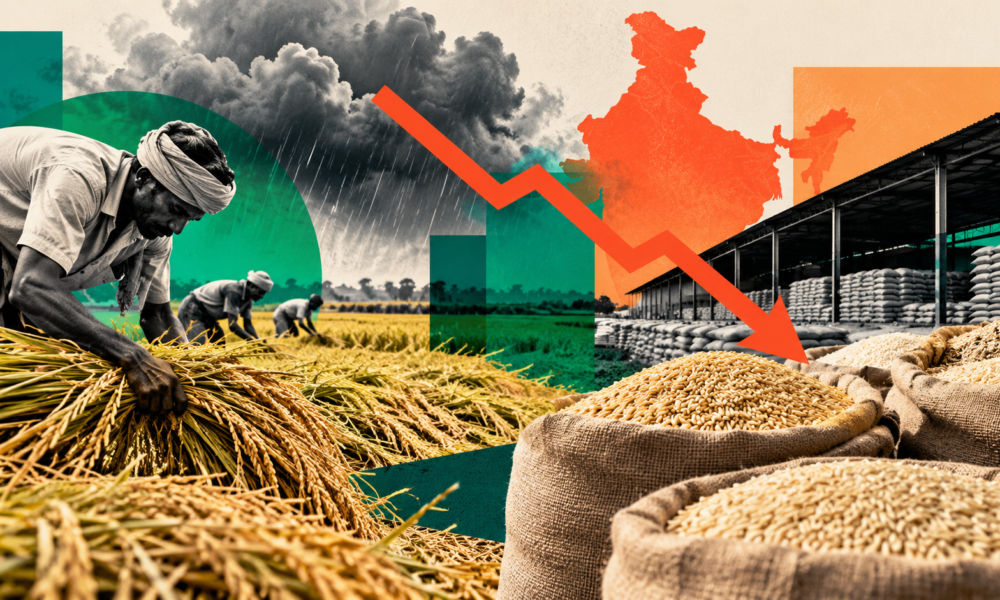
India’s government agencies procured approximately 13 million tonnes of paddy between October 1 and October 28, compared with 16.9 million tonnes during the corresponding period last year, highlighting challenges in the country’s agricultural procurement and storage infrastructure.
According to a report published by Mint on October 30, procurement has been affected by erratic weather conditions and delays in moving purchased grain from procurement regions because of storage constraints.
The development comes during the 2026–27 Kharif Marketing Season, when government agencies are working to procure paddy from farmers across major agricultural states.
The government has set a procurement target of approximately 71.95 million tonnes for the season.
Procurement declines across the initial weeks
The reported procurement of 13 million tonnes represents a decline of approximately 23% compared with the 16.9 million tonnes purchased during the same period last year.
Punjab accounted for the largest share of procurement, with approximately 8.86 million tonnes purchased by October 28.
Haryana followed with 3.60 million tonnes, while Tamil Nadu recorded procurement of approximately 418,987 tonnes.
The figures underline the importance of northern India’s agricultural procurement network in the country’s food supply system.
Weather and storage capacity create challenges
Weather conditions have emerged as one of the factors affecting procurement activity.
Erratic rainfall and changing harvesting conditions can influence the arrival of harvested paddy at procurement centres.
Storage constraints have also affected the movement of purchased grain.
Once procurement agencies purchase paddy, the grain needs to be transported, stored and processed through an extensive network of warehouses, mills and logistics facilities.
If storage space becomes unavailable or transportation is delayed, procurement operations can slow down.
These challenges highlight the relationship between agricultural output and infrastructure capacity.
Government procurement target for 2026–27
The government has maintained a procurement target of approximately 71.95 million tonnes for the 2026–27 Kharif Marketing Season.
The target is broadly comparable with the previous year’s target despite concerns relating to monsoon conditions and cultivated area.
The Central Foodgrains Procurement Portal provides information about procurement activity, registered farmers, transactions and minimum support price payments.
As of its October 30 refresh, the portal reported approximately 64.94 lakh tonnes of paddy procured during the current season.
The portal also reported that 32.48 lakh farmers had registered, while 4.18 lakh farmers had completed transactions.
These figures represent the portal’s reported data and should be distinguished from the separate cumulative figures reported by Mint for October 1–28.
Uttar Pradesh expands procurement arrangements
Uttar Pradesh has also announced an ambitious procurement programme for the season.
According to an India Today report published on October 13, the state has set a procurement target of 65 lakh tonnes.
The state government has announced payments of ₹2,441 per quintal for common-grade paddy and ₹2,461 per quintal for Grade A paddy.
Procurement is being organised in two phases, reflecting regional differences in crop maturity.
Western Uttar Pradesh’s procurement period runs from October 15, 2026, to February 15, 2027, while eastern Uttar Pradesh’s schedule runs from November 1, 2026, to February 28, 2027.
Why agricultural infrastructure matters
The procurement process depends on a coordinated system involving procurement centres, transport networks, storage facilities, rice mills and distribution infrastructure.
Insufficient storage or transportation capacity can affect the movement of agricultural commodities and increase operational pressure during peak procurement periods.
Strengthening warehouses, improving logistics and expanding digital monitoring systems can help improve procurement efficiency.
The latest procurement figures highlight why agricultural infrastructure is as important as agricultural production.
India’s ability to maintain an efficient food procurement system will depend on coordination between farmers, government agencies, storage operators and transport providers.






No Comment! Be the first one.