





India’s Next Infrastructure Challenge: Why Water Could Shape Future Industrial Growth
The energy requirements of India’s data centre sector are coming under greater scrutiny as the country rapidly expands its capacity in this field. Data centres require water for cooling, making water...

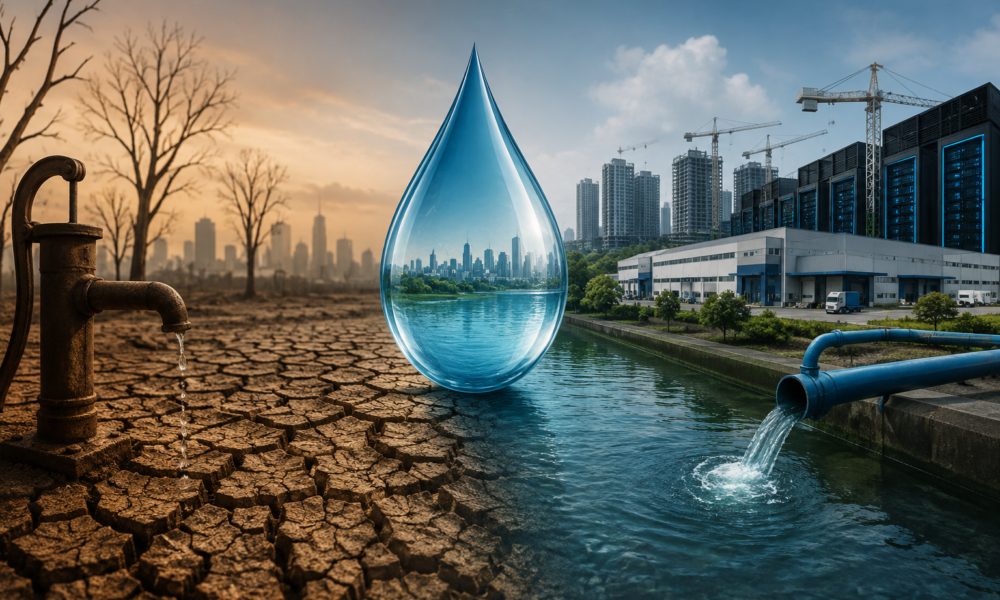
The energy requirements of India’s data centre sector are coming under greater scrutiny as the country rapidly expands its capacity in this field. Data centres require water for cooling, making water availability an increasingly important concern alongside the growing demand for computing capacity driven by AI. Recent reporting has also highlighted the exploration of seawater cooling and desalination as the sector looks for alternatives in water-stressed locations. This could affect where India builds data centres, logistics parks and large urban developments. Water availability is emerging as a potential factor in industrial investment decisions alongside land, labour and connectivity.
The World Bank’s March 2026 assessment provides a strong statistic: India has 18% of the world’s population but only 4% of its water resources. The report adds that around 600 million people face water stress, while per-capita water availability has fallen by roughly half since 1970. Water-dependent sectors contribute roughly half of India’s economic value added and employ nearly 70% of the workforce.
There is another useful infrastructure figure from the Central Water Commission. India’s estimated average per-capita water availability is 1,434 cubic metres in 2025 and is projected to fall to 1,219 cubic metres by 2050. The CWC defines availability below 1,700 cubic metres as water-stressed and below 1,000 cubic metres as water-scarce.
For an ordinary household, water stress can mean higher water costs, greater dependence on tankers and more restrictions on supplies for homes, farms and businesses. But there is also a less obvious connection: when a city attracts a large factory, data centre, warehouse cluster or township, it needs much more than land and roads.
It needs water pipelines, sewage systems, treatment plants, reservoirs, drainage and reliable power. The World Bank estimates that by 2036, 600 million people could live in India’s urban areas, increasing pressure on already stretched urban infrastructure and services, including access to clean water.
So the question is not simply whether India has enough water. It is also whether its infrastructure can deliver, recycle and manage water in the places where the country’s next wave of economic growth is taking place.
For decades, companies and investors have primarily considered factors such as land, labour, power, roads, ports and connectivity when choosing locations for their assets. As water stress increases, the equation could increasingly include water security alongside these factors.
Several major industries could be affected by growing water stress. Manufacturing sectors such as semiconductors, electronics, chemicals and pharmaceuticals require reliable water supplies as well as effective wastewater management.
Moreover, new housing and commercial districts cannot function without dependable municipal water and sewage infrastructure. This could change how investors evaluate infrastructure locations. A location with cheap land but unreliable water may become less attractive than a slightly more expensive location with strong water infrastructure.
Water could increasingly be treated as an economic asset rather than simply an issue of dams and pipelines. Water recycling and reuse, industrial wastewater treatment and desalination could become increasingly important parts of India’s infrastructure strategy.
This could affect real estate valuations and industrial location decisions.
Water availability could increasingly become a factor in deciding where India’s next factories, data centres and large developments are built.




No Comment! Be the first one.