







Indian Oil Approves ₹2,449 Crore Kochi–Thoothukudi Gas Pipeline: 425-Km Energy Corridor to Strengthen Southern India
Indian Oil Corporation Ltd (IndianOil) has approved an investment of ₹2,448.70 crore to develop the Kochi–Kanyakumari–Thoothukudi Natural Gas Pipeline (KTPL), creating a new gas transmission corridor...

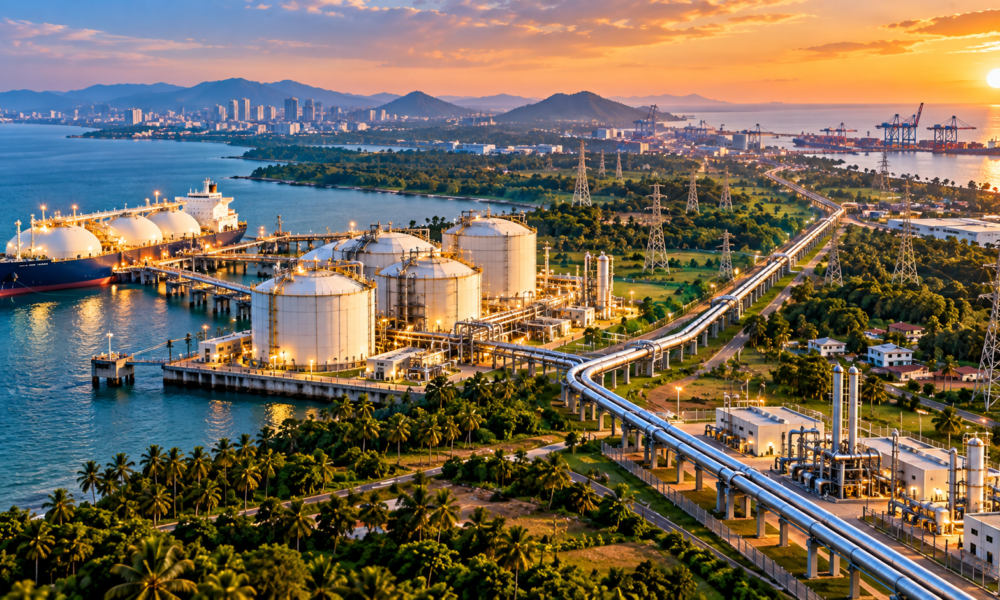
Indian Oil Corporation Ltd (IndianOil) has approved an investment of ₹2,448.70 crore to develop the Kochi–Kanyakumari–Thoothukudi Natural Gas Pipeline (KTPL), creating a new gas transmission corridor between Kerala and southern Tamil Nadu.
The proposed pipeline will stretch 424.65 km, connecting the Kochi LNG terminal with Thoothukudi through the Kanyakumari region. It will have a designed transmission capacity of 6.84 million standard cubic metres per day (MMSCMD), including 1.71 MMSCMD of common-carrier capacity.
A new gas corridor for southern India
The project will originate at the Kochi LNG terminal and transport regasified LNG towards demand centres in Kerala and southern Tamil Nadu.
The Petroleum and Natural Gas Regulatory Board (PNGRB) had authorised IndianOil to develop the pipeline in April 2026 following a competitive bidding process. PNGRB said the project is intended to strengthen natural gas transmission infrastructure and improve connectivity with the wider gas network.
The proposed route is expected to pass through areas including Kottayam, Kottarakkara, Kattakkada and Nagercoil before reaching Thoothukudi.
6.84 MMSCMD capacity
The pipeline’s total system capacity is planned at 6.84 MMSCMD.
Of this, 1.71 MMSCMD will be available as common-carrier capacity. This means a designated portion of the pipeline can be used by eligible third parties under the applicable regulatory framework, rather than being restricted entirely to IndianOil or its own customers.
This feature could allow more gas suppliers and industrial users to access the transmission network as demand develops along the corridor.
Industries, power plants and city gas networks
The infrastructure is expected to support several categories of gas demand.
According to PNGRB, the pipeline can facilitate expansion of City Gas Distribution (CGD) networks and supply gas to industrial consumers, power plants and other downstream users. It is also expected to improve natural gas availability in Kerala and southern Tamil Nadu and strengthen integration with the national gas grid.
For cities, greater pipeline connectivity can support the expansion of PNG and CNG networks, while industrial clusters can gain access to another gas transportation route.
For the energy sector, the corridor can provide infrastructure for moving regasified LNG from the Kochi terminal towards southern demand centres.
It connects with existing infrastructure
The KTPL is not being developed as an isolated pipeline.
The proposed system is expected to connect with the existing Kochi–Koottanad–Bengaluru–Mangaluru Pipeline (KKBMPL) network, creating greater integration between southern India’s gas infrastructure systems.
IndianOil also operates the Ennore–Tuticorin–Bengaluru R-LNG Pipeline, which has an installed capacity of 34.67 MMSCMD and supplies industrial customers and city gas networks in Tamil Nadu.
Together, these networks form part of a broader effort to expand India’s natural-gas transmission infrastructure.
Why this matters for infrastructure
The project highlights how India’s infrastructure expansion is moving beyond roads, railways and airports into energy-connectivity infrastructure.
A functioning gas corridor requires more than the pipeline itself. It involves LNG terminals, compression and transmission systems, industrial connections, city gas distribution networks and links with the national gas grid.
For southern India, the KTPL could therefore become an additional piece of the region’s energy infrastructure, particularly for industrial and urban gas demand.
However, IndianOil’s regulatory filing does not currently specify a construction schedule or commissioning date, so the ₹2,448.70 crore figure represents the approved project investment rather than completed infrastructure.






No Comment! Be the first one.