








India’s Data Centre Pipeline Reaches 3,860 MW as AI and Cloud Demand Accelerate Expansion
India’s data centre industry is entering a major infrastructure expansion cycle as artificial intelligence, cloud computing, digital services and rising data consumption increase demand for computing...

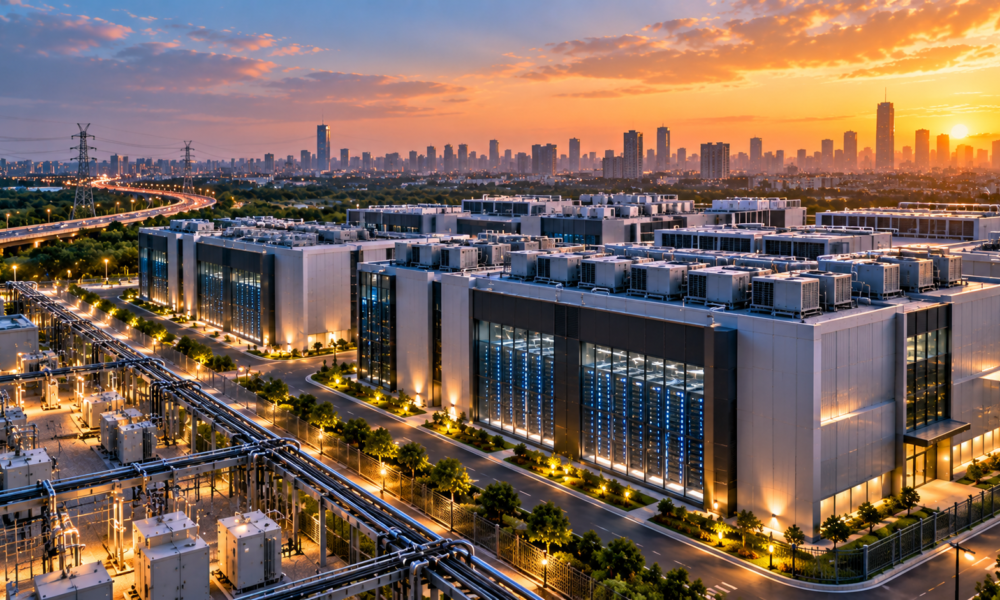
India’s data centre industry is entering a major infrastructure expansion cycle as artificial intelligence, cloud computing, digital services and rising data consumption increase demand for computing capacity.
According to Cushman & Wakefield’s India Data Centre H1 2026 update, the country’s top seven data centre markets added 178 MW of new capacity during the first half of 2026. This took India’s operational data centre capacity to approximately 1,789 MW.
The bigger development is the pipeline ahead. India is expected to receive another 3,860 MW of data centre capacity by 2030.
Of this upcoming capacity, approximately 509 MW is already under construction, while another 3,351 MW is in the planning stage.
The numbers highlight the scale of infrastructure required to support India’s digital economy.
Data centres are no longer simply large buildings filled with servers. Their development depends on reliable electricity, fibre connectivity, cooling infrastructure, land availability and access to resilient networks.
Artificial intelligence is adding another layer to these requirements because AI workloads can demand significantly greater computing power and energy capacity.
Mumbai remains India’s largest data centre market, with approximately 890 MW of operational capacity and an upcoming pipeline of around 1,726 MW.
However, growth is increasingly spreading across other cities.
Hyderabad has around 151 MW of operational capacity and approximately 710 MW of upcoming supply. Chennai has around 214 MW operational and another 368 MW in the pipeline.
Delhi-NCR has approximately 183 MW of operational capacity and another 387 MW of upcoming supply, while Pune has around 133 MW operational and 258 MW planned or under development.
Bengaluru and Kolkata are also expanding their data centre ecosystems.
The geographical diversification is significant because data centres require more than a strong technology workforce. Power availability, connectivity, land costs, regulatory conditions and proximity to major users all influence where facilities are developed.
The sector is also becoming increasingly relevant to real estate investors.
A data centre occupies physical real estate, but its value is closely linked to infrastructure performance. Power supply, cooling systems, connectivity and computing density can be just as important as the location of the building.
The expansion is attracting significant capital. Cushman & Wakefield estimates that India could require approximately $29.9 billion in development capital through 2030 for its data centre expansion.
The broader Asia-Pacific market is also experiencing rapid growth, with regional capacity projected to increase 2.7 times by 2030.
For Indian cities, the data centre boom could have wider consequences. Large facilities require power infrastructure, transmission networks, fibre connectivity and supporting industrial ecosystems.
They can also increase demand for land in locations capable of accommodating large-scale digital infrastructure.
As AI adoption accelerates, India’s data centre requirements could therefore become increasingly intertwined with real estate, energy and infrastructure planning.
The 3,860 MW pipeline represents more than a construction number. It signals the physical infrastructure required to support India’s next phase of digital growth.









No Comment! Be the first one.