





Mumbai Coastal Road After One Year: What the Traffic Numbers Tell Us
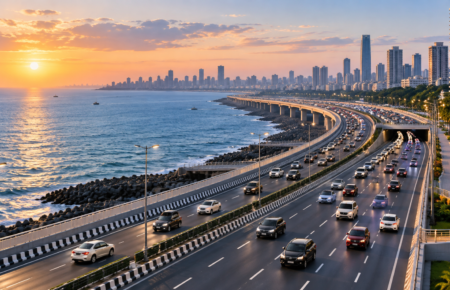
Mumbai: The Mumbai Coastal Road has seen a sharp increase in usage since it began operating 24 hours a day, with average daily traffic rising by nearly 81% over the past year. The southern section of...

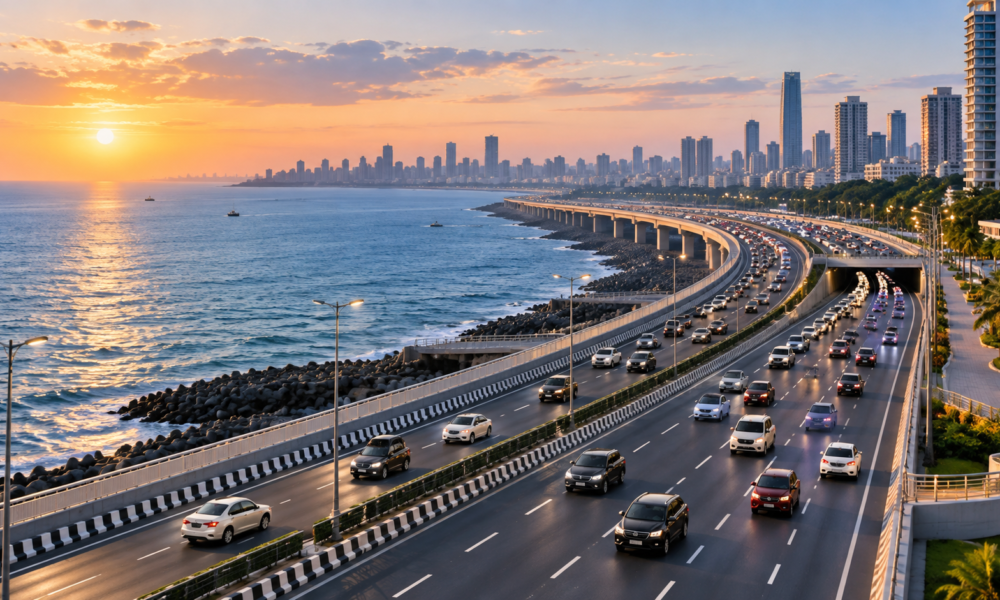
Mumbai: The Mumbai Coastal Road has seen a sharp increase in usage since it began operating 24 hours a day, with average daily traffic rising by nearly 81% over the past year.
The southern section of the Coastal Road began 24×7 operations on 15 August 2025. Since then, average daily traffic has increased from around 34,500 vehicles to 62,640 vehicles.
The ₹13,984-crore project was opened in phases from March 2024 and was initially available to motorists for 18 hours a day, from 7am to midnight.
Traffic Rises After 24×7 Operations
Before round-the-clock operations began, the road carried an average of 34,538 vehicles a day.
This included around 19,209 vehicles travelling southbound and 15,330 travelling northbound.
After 24×7 operations began, average daily traffic increased to 62,640 vehicles, comprising around 33,077 southbound and 29,563 northbound vehicles.
Monthly usage has also increased significantly.
Before 15 August 2025, the Coastal Road recorded around 11.35 lakh vehicle movements per month. In the following year, this increased to nearly 18.79 lakh vehicle movements, representing a rise of around 66%.
Since the first section of the Coastal Road opened in March 2024, around 4.11 crore vehicles have used the southern section.
Traffic Still Below Original Projections
Despite the increase in usage, the road has not yet reached the traffic levels originally projected during the planning stage.
Planners had estimated that nearly 68,000 cars could use the road in one direction alone once the system was fully operational.
Urban planner Alan Abraham said the current traffic levels remain around half of the original expectation. He also questioned whether adding more road capacity necessarily improves traffic conditions across an entire city.
His argument is that additional road capacity can divert existing traffic to a new route without necessarily reducing congestion across the wider network.
Public Transport Remains a Concern
Another issue highlighted in the report is public transport.
The Coastal Road is primarily designed for motor vehicles, while pedestrians, two-wheelers and heavy vehicles are not permitted on the route.
MLA Rais Shaikh has called for additional BEST bus services along the corridor, arguing that better public transport connections are needed alongside the road project.
At present, two BEST routes, A84 and A78, operate along parts of the wider corridor.
Residents Point to Better Connectivity
Residents have also reported benefits from the project.
Susieben Shah, general secretary of the Malabar Hill Citizens Forum, described the Coastal Road as a major improvement for residents, particularly because of better connectivity and potential reductions in travel time.
The proposed extension towards the north could further expand these connectivity benefits.
Safety and Maintenance Challenges
The project has also faced several operational challenges.
These have included incidents involving fires, water leakage, tunnel infrastructure and electrical systems.
In July, a vehicle fire inside the southbound tunnel caused traffic to be temporarily stopped. In another incident, maintenance workers found that bolts and copper wiring had been removed from an electrical pole at Worli.
Transport expert Vivek Pai said incidents of this kind need to be addressed through proper safety procedures and emergency preparedness.
What Happens Next?
The Coastal Road is part of a larger network of transport projects planned to improve connectivity across Mumbai.
The proposed Versova-Bandra Sea Link could eventually extend the wider road network towards the western suburbs.
Civic authorities have also highlighted the role of the Integrated Command and Control Centre at Breach Candy, which brings together traffic management, tunnel ventilation, firefighting and surveillance systems.
The first year of 24×7 operations therefore provides an early picture of how Mumbai’s major coastal infrastructure is being used. While traffic has increased substantially, questions remain around future capacity, public transport, safety and how effectively the project will integrate with the city’s wider transport network.




No Comment! Be the first one.