





Telangana Approves 7,300 MW Renewable Energy Procurement with 8,000 MWh Storage: Can Battery Infrastructure Transform India’s Power Grid?
Telangana is preparing to expand its renewable energy infrastructure with a major power procurement plan involving 7,300 MW of renewable electricity and 8,000 MWh of energy storage. The Telangana...

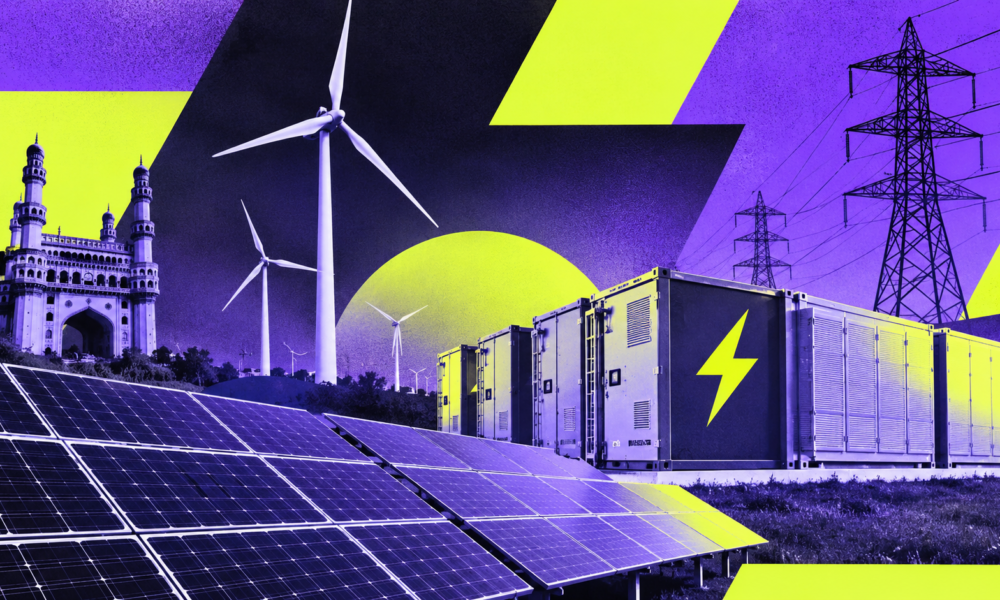
Telangana is preparing to expand its renewable energy infrastructure with a major power procurement plan involving 7,300 MW of renewable electricity and 8,000 MWh of energy storage. The Telangana Electricity Regulatory Commission (TGERC) has granted in-principle approval to the state’s two electricity distribution companies to proceed with the proposed procurement.
The initiative involves the Telangana State Southern Power Distribution Company Limited (TGSPDCL) and the Telangana State Northern Power Distribution Company Limited (TGNPDCL). It aims to strengthen electricity availability, support rising consumption and improve the reliability of renewable power across the state.
Four Components of Telangana’s Renewable Energy Plan
The approved procurement framework includes four major components, combining solar, wind and storage technologies.
The first component involves 800 MW of standalone wind power under a 25-year agreement. The second covers 3,000 MW of solar power integrated with a 6,000 MWh Battery Energy Storage System (BESS). This system is configured to provide 1,000 MW of power for six hours.
The third component involves 2,000 MW of renewable energy round-the-clock (RE-RTC) power under a 25-year agreement. The fourth provides 2,000 MWh of firm and dispatchable renewable energy, configured at 500 MW for four hours under a 15-year agreement.
Together, these arrangements are intended to provide a more dependable renewable electricity supply while addressing peak consumption requirements.
Why Does Telangana Need Battery Energy Storage?
Solar and wind power generation depends on weather conditions and cannot always match electricity consumption patterns.
Solar installations generally produce the most electricity during daylight hours, while household and commercial demand can remain high in the evening. Wind generation also fluctuates depending on local weather conditions.
Battery storage can help address this mismatch by storing surplus electricity and releasing it when demand increases.
For Telangana, integrating 6,000 MWh of battery storage with its proposed solar procurement could help shift a portion of daytime generation towards evening consumption.
The additional firm and dispatchable renewable energy component is also designed to provide electricity during specified peak-demand periods.
Rising Electricity Demand Is Driving Infrastructure Investment
The procurement plan comes as Telangana prepares for higher electricity consumption over the coming decade.
According to figures cited in the state’s resource adequacy planning, annual electricity requirements are projected to increase from 108.13 billion units in FY2026-27 to 177.22 billion units by FY2035-36. Peak demand is also projected to rise by approximately 49.4% over the same period. <Cite refs={[“turn839080view2”]}/>
This growth could increase pressure on generation capacity, transmission networks and distribution infrastructure.
Long-term power procurement agreements can help utilities plan electricity availability while supporting renewable consumption obligations.
What Does This Mean for India’s Infrastructure Industry?
The expansion could create opportunities across several infrastructure segments.
Battery manufacturers, renewable energy developers, engineering, procurement and construction companies, transmission operators and power management technology providers could benefit from increased project activity.
The plan also highlights the growing importance of grid-scale battery storage in India’s energy transition.
However, procurement approval is not the same as project commissioning. The utilities must still progress through bidding, tariff evaluation, contracting and implementation.
The commercial viability of the projects will depend on electricity prices, battery costs, financing arrangements and the development of supporting grid infrastructure.
The Bigger Picture
Telangana’s proposed 7,300 MW renewable energy procurement highlights an important shift in India’s electricity planning.
The next phase of renewable energy expansion will require more than solar panels and wind turbines. It will also depend on storage systems, transmission networks and technologies capable of balancing electricity supply with demand.
If implemented effectively, Telangana’s plan could provide a useful model for integrating large-scale renewable generation with battery storage.
For India’s infrastructure industry, the opportunity is clear: building the power generation capacity of the future will also mean building the systems that make clean electricity available when people and businesses need it most.




No Comment! Be the first one.