




500-tonne girder launched for Sion ROB under Mumbai rail expansion project
Mumbai’s rail infrastructure upgrade has crossed a major engineering milestone with the successful launch of a 500-tonne steel girder for the reconstruction of the Sion Road Over Bridge (ROB), a key...

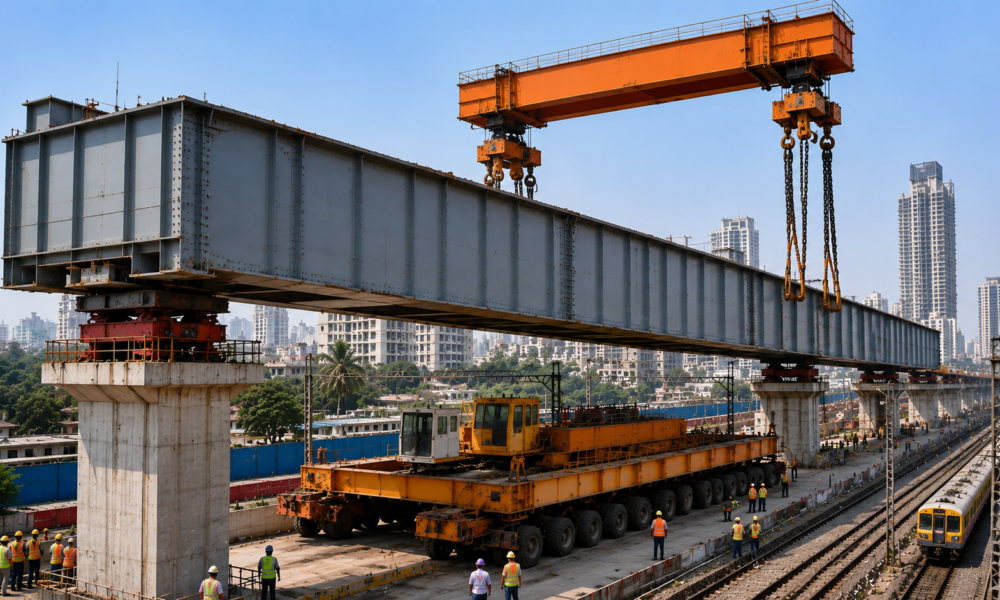
Mumbai’s rail infrastructure upgrade has crossed a major engineering milestone with the successful launch of a 500-tonne steel girder for the reconstruction of the Sion Road Over Bridge (ROB), a key component of the CSMT-Kurla fifth and sixth railway line expansion project. The development is part of a larger effort to strengthen suburban rail capacity in one of the country’s busiest urban transport networks and ease pressure on critical east-west commuter corridors in the city.
According to project details reported on Tuesday, the girder launch was carried out as part of the rebuilding of the Sion ROB, which sits on an important stretch linking neighbourhood-level road movement with one of Mumbai’s most heavily used railway sections. The bridge work is tied to the broader plan to add fifth and sixth railway lines between Chhatrapati Shivaji Maharaj Terminus (CSMT) and Kurla, a capacity augmentation project aimed at separating suburban and outstation rail traffic more efficiently and improving operational flexibility on the corridor.
The significance of the Sion ROB milestone lies not only in the scale of the steel launch, but also in what it represents for Mumbai’s long-delayed rail decongestion agenda. The CSMT-Kurla stretch is one of the most critical rail links in the Mumbai suburban system, carrying a heavy mix of local train services, long-distance rail traffic and freight movement. As train frequency and passenger demand continue to rise, infrastructure bottlenecks on legacy corridors have increasingly pushed railway authorities to pursue line expansion, bridge reconstruction and station-area upgrades to keep the system functional and future-ready.
The fifth and sixth line project is expected to play a crucial role in enhancing throughput on the Central Railway network by allowing better segregation of train operations. In practical terms, that means suburban services could eventually run with greater efficiency, while longer-distance trains get additional track capacity, reducing scheduling conflicts and operational delays. Projects like the Sion ROB reconstruction are essential to that transition because bridges, crossings and overpasses along the route need to be redesigned to accommodate the wider rail footprint created by additional tracks.
For Mumbai, the project also reflects a larger pattern in infrastructure planning: capacity upgrades are no longer limited to adding trains or increasing service frequency, but increasingly depend on rebuilding old supporting structures that were designed for a different era of urban mobility. In dense cities like Mumbai, where land constraints make greenfield transport development difficult, brownfield upgrades to rail corridors, bridges and interchanges often become the most viable route to improving connectivity. The Sion ROB is a textbook example of that challenge. It is not a standalone bridge project, but a supporting piece of a much larger rail modernisation puzzle.
The successful launch of a 500-tonne girder also highlights the growing engineering complexity of urban transport construction in live, high-density environments. Such works require careful traffic planning, railway block coordination, safety management and precise execution, especially in a city where both road and rail networks remain in constant use. That is why milestones like these matter for infrastructure watchers: they indicate that the project is moving through the hard execution phase rather than remaining stuck in planning or approval cycles.
For XInfra readers, the Sion ROB development is worth tracking because it captures the core of India’s urban infrastructure story today: upgrading legacy systems, expanding rail capacity, and using targeted engineering interventions to improve mobility in already saturated cities. As the CSMT-Kurla fifth and sixth line project progresses, the pace of associated bridge and corridor works will be critical in determining how quickly Mumbai can unlock additional suburban rail capacity for the millions who depend on it every day.







No Comment! Be the first one.