







J&K Budget 2026-27 Prioritises Infrastructure with ₹331 Billion Capital Outlay, Focus on Roads and Connectivity
The Jammu and Kashmir government has unveiled its Budget for the financial year 2026-27 with a strong emphasis on infrastructure development, allocating ₹331.27 billion towards capital expenditure as...

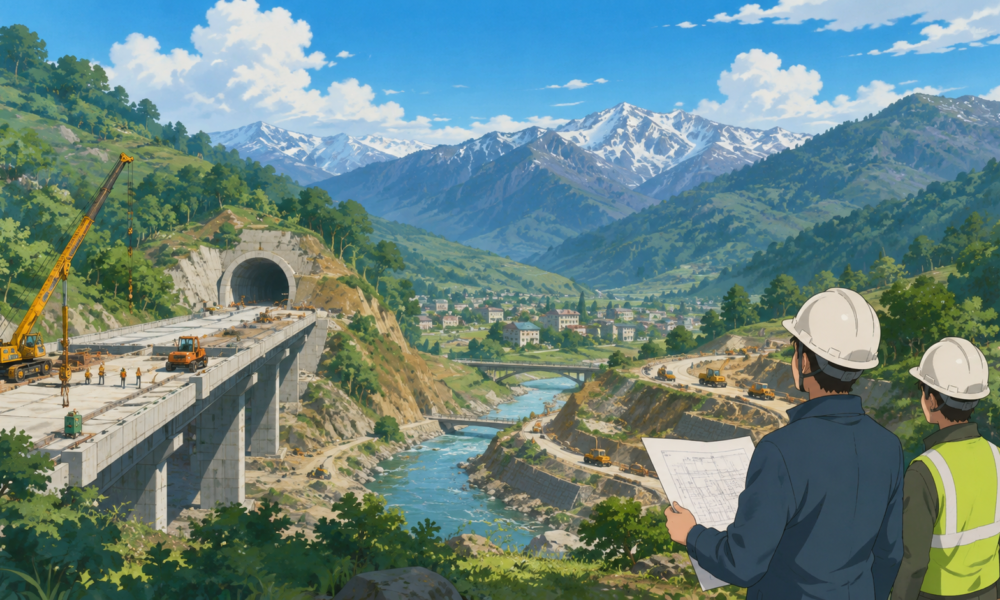
The Jammu and Kashmir government has unveiled its Budget for the financial year 2026-27 with a strong emphasis on infrastructure development, allocating ₹331.27 billion towards capital expenditure as part of a total budget outlay of ₹1.14 trillion. While the capital allocation is marginally lower than the previous year’s ₹335 billion, the administration has retained infrastructure as the centrepiece of its economic strategy, particularly through investments in roads, transport and regional connectivity.
The budget proposes ₹806.40 billion for revenue expenditure and projects total revenue receipts of ₹900.18 billion, with Jammu and Kashmir’s own tax and non-tax revenues estimated at ₹318 billion. The Union Territory will continue to rely significantly on central support, with grants and tax devolution contributing more than ₹427 billion to the government’s finances.
Infrastructure remains the largest beneficiary of public spending this year. The government has earmarked over ₹615.28 billion towards road construction, highways, tunnels and transport infrastructure, marking a substantial increase in funding for connectivity projects compared to the previous budget. The investment is expected to strengthen regional mobility, improve logistics and support tourism while creating short-term employment during the construction phase.
Improved transport infrastructure has long been viewed as a critical requirement for Jammu and Kashmir’s economic development. Better road connectivity is expected to reduce travel time between remote districts, improve access to markets for local businesses and strengthen supply chains for agriculture, tourism and manufacturing sectors.
However, industry experts argue that infrastructure investment alone may not be sufficient to attract sustained private investment.
Corporate law expert Mushtaq Dar noted that investors continue to prioritise regulatory certainty, faster approvals and predictable governance alongside physical infrastructure. According to him, while initiatives such as the Single Window Clearance System exist, implementation remains inconsistent, often resulting in lengthy approval timelines due to administrative delays and limited decision-making at the departmental level.
Dar further observed that improving the ease of doing business requires greater investment in institutional capacity, including legal training for officials, clear operational guidelines and stronger enforcement of service delivery timelines under existing laws. Without these reforms, infrastructure announcements alone may not translate into higher private investment, he said.
Beyond infrastructure, the budget provides modest increases for healthcare and education. Healthcare and medical education have received ₹18.66 billion, up from ₹17.51 billion last year, with funding aimed at hospital upgrades, diagnostic services, telemedicine and expanding medical education facilities. Education allocations have also increased to ₹15.13 billion, supporting school infrastructure, digital learning and skill development initiatives.
In contrast, agriculture and rural development have witnessed lower allocations. Agriculture has been allocated ₹18.78 billion, down from ₹22.22 billion in the previous fiscal, while rural development funding has declined to ₹34.56 billion from ₹37.74 billion. The government has indicated that central schemes will help bridge the funding gap, although stakeholders have raised concerns about reduced fiscal flexibility at the local level.
The budget has also sparked political debate, with opposition leaders questioning whether the spending plan adequately addresses employment generation and welfare commitments. Youth unemployment remains a significant concern across the Union Territory, and many stakeholders have called for a clearer roadmap for job creation alongside infrastructure expansion.
For the infrastructure sector, however, the 2026-27 budget signals continued public investment in strategic connectivity projects that could improve regional accessibility and strengthen long-term economic development. The pace of project execution, administrative reforms and the government’s ability to attract private capital will ultimately determine whether these investments translate into sustainable growth.








No Comment! Be the first one.