






India’s First Greenfield Refinery-Cum-Petrochemical Complex Set to Reshape Western India’s Industrial Landscape
India is preparing to strengthen its industrial and energy infrastructure with the development of its first greenfield integrated refinery-cum-petrochemical complex at Pachpadra in Rajasthan. Built...

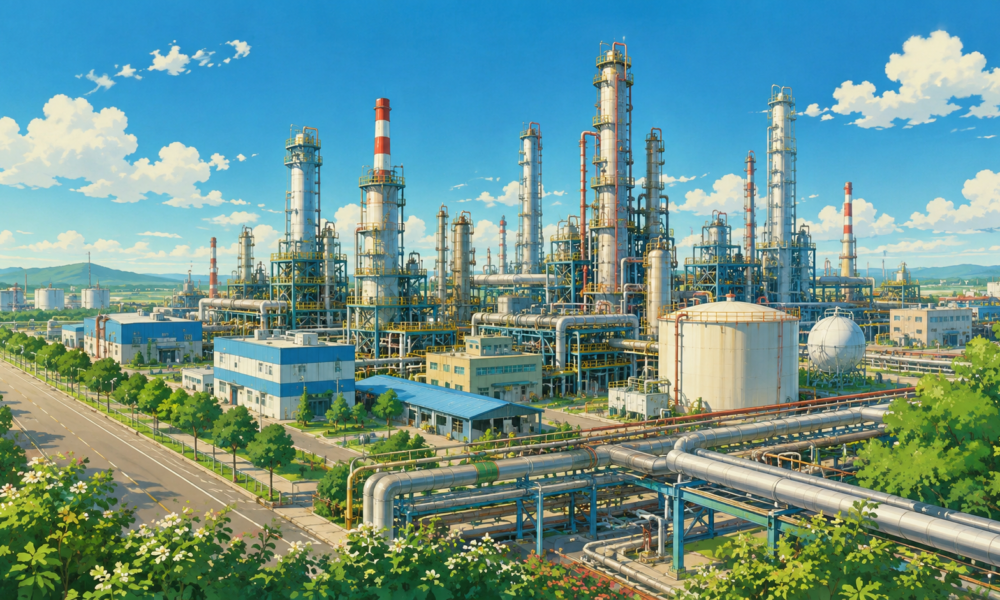
India is preparing to strengthen its industrial and energy infrastructure with the development of its first greenfield integrated refinery-cum-petrochemical complex at Pachpadra in Rajasthan. Built at an investment of over ₹79,450 crore, the project is expected to become one of the country’s largest energy and manufacturing hubs, creating fresh opportunities for industries, logistics providers and infrastructure developers across western India.
The refinery, developed by HPCL Rajasthan Refinery Limited (HRRL), a joint venture between Hindustan Petroleum Corporation Limited (HPCL) and the Government of Rajasthan, has a refining capacity of 9 million metric tonnes per annum (MMTPA). Unlike conventional refineries that primarily produce transport fuels, the integrated complex will also manufacture petrochemicals used in packaging, textiles, pharmaceuticals, automotive components, consumer goods and industrial products.
The project represents much more than an energy investment. It is expected to trigger the development of a wider industrial ecosystem supported by transport, logistics and utility infrastructure. Large integrated industrial facilities require reliable highways, railway connectivity, pipelines, power supply, water infrastructure, warehousing and storage facilities. As these supporting assets develop, Pachpadra is likely to emerge as one of India’s key industrial growth centres.
The refinery is also expected to strengthen India’s petrochemical manufacturing capabilities at a time when domestic demand for polymers and speciality chemicals continues to rise. Increasing local production could reduce import dependence while creating a stronger supply chain for downstream manufacturers.
For Rajasthan, the project marks an important step towards economic diversification. While the state has established itself in mining, cement production and renewable energy, the refinery is expected to attract fresh investments from chemical manufacturers, engineering companies, packaging firms and logistics operators looking to establish operations close to a major industrial hub.
Infrastructure connectivity will play a critical role in the success of the project. The refinery is supported by road, rail and pipeline networks that will allow efficient transportation of crude oil, refined fuels and petrochemical products across northern and western India. Improved connectivity is expected to reduce logistics costs while strengthening supply chain efficiency for manufacturers.
The project also aligns with the Government of India’s broader vision of creating integrated industrial corridors rather than standalone manufacturing facilities. Modern industrial infrastructure increasingly depends on seamless connectivity, dependable utilities and efficient logistics to remain globally competitive.
Beyond industrial output, the refinery is expected to generate thousands of direct and indirect employment opportunities across engineering, construction, operations, maintenance, logistics and industrial services. Growth in economic activity is also likely to accelerate urban development in surrounding areas through higher demand for housing, healthcare, education and commercial infrastructure.
The complex incorporates modern refining technologies designed to improve operational efficiency and maximise resource utilisation. Although petroleum products remain central to the energy mix, integrated refineries offer better value addition by converting a larger share of crude oil into high-value petrochemical products.
Industry observers believe the Pachpadra refinery could become a catalyst for western India’s next phase of industrial growth. By combining energy production with petrochemical manufacturing and supporting infrastructure, the project is expected to strengthen India’s manufacturing base while improving energy security and boosting regional economic development.
As India continues investing in large-scale industrial infrastructure, projects such as the Pachpadra refinery highlight how integrated developments can create long-term value beyond their primary function. The project has the potential to reshape Rajasthan’s industrial landscape while reinforcing India’s position as a growing global manufacturing destination.








No Comment! Be the first one.