








India Tracks 1,775 Infrastructure Projects Worth ₹37.11 Lakh Crore as Cost Estimates Rise
India is monitoring 1,775 ongoing Central Sector infrastructure projects with a combined revised cost of ₹37.11 lakh crore, according to the latest data from the Ministry of Statistics and Programme...

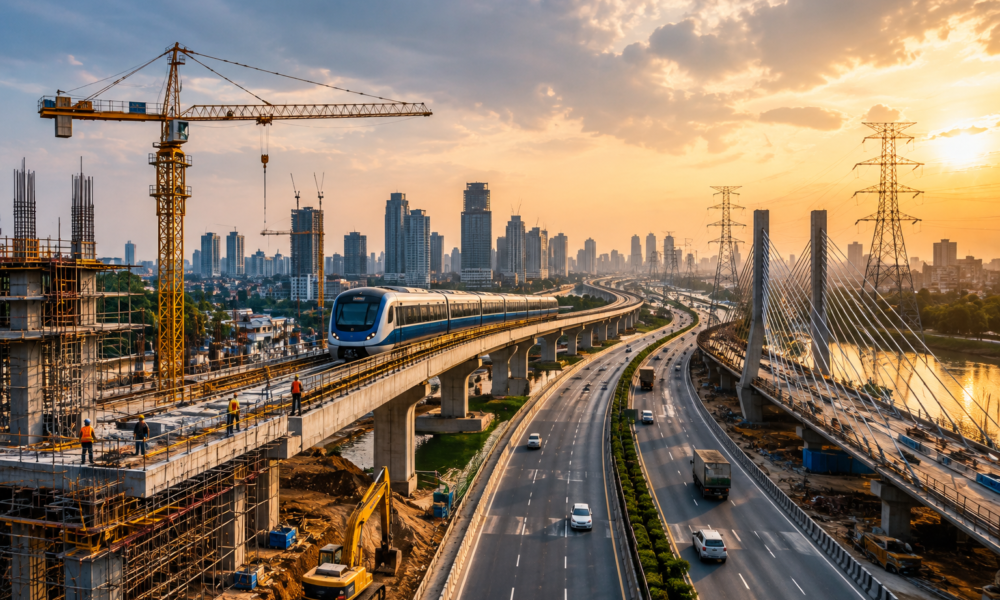
India is monitoring 1,775 ongoing Central Sector infrastructure projects with a combined revised cost of ₹37.11 lakh crore, according to the latest data from the Ministry of Statistics and Programme Implementation (MoSPI). The projects span 17 Central Ministries and Departments and cover major areas including roads, railways, energy, urban infrastructure, water and telecommunications.
The figures are part of MoSPI’s Flash Report on Central Sector Infrastructure Projects costing ₹150 crore and above for July 2026. The report shows that the revised cost of the 1,775 projects has increased from an original estimate of ₹33.70 lakh crore to ₹37.11 lakh crore. This represents a cumulative increase of around ₹3.4 lakh crore, or about 10.1%, in estimated project costs.
At the same time, cumulative expenditure on the projects has reached ₹19.26 lakh crore, equivalent to about 51.91% of their revised cost. The data indicates that more than half of the revised project expenditure has already been incurred.
A significant number of projects are also approaching completion. MoSPI reported that 675 projects, or around 38% of the total, have achieved more than 80% physical progress. Another 305 projects, representing about 17%, have crossed 80% financial completion. The pipeline therefore includes both recently started projects and large developments that are nearing the final stages of construction.
Transport and logistics account for the largest share of the infrastructure pipeline. The sector includes roads and highways, railways, aviation, urban public transport, shipping and inland waterways. It covers 1,246 projects with a combined revised cost of ₹19.81 lakh crore, representing around 53% of the total revised project cost.
Energy is the second-largest sector, with 205 projects worth ₹10.66 lakh crore. These projects include oil and gas infrastructure, power generation, transmission and distribution networks and energy storage.
Roads remain the largest individual area by project count. The Ministry of Road Transport and Highways is monitoring 993 projects with a revised cost of ₹9.62 lakh crore. The Ministry of Railways has 190 projects worth ₹6.38 lakh crore. Other major portfolios include 121 coal projects worth ₹2.22 lakh crore, 103 petroleum and natural gas projects worth ₹4.23 lakh crore and 98 power projects worth ₹6.08 lakh crore.
The July data also brought 36 new projects into the monitoring system. These included 16 telecommunications projects, nine steel projects, six road projects, three projects under the Department for Promotion of Industry and Internal Trade, and one each under Housing and Urban Affairs and Power.
Among the notable additions were the ₹38,358 crore Meja Thermal Power Project Stage II, the ₹13,037.66 crore Jaipur Metro Rail Project Phase 2 and a ₹1,418.16 crore greenfield Varanasi-Ranchi-Kolkata highway project.
Several projects were also commissioned during July. These included the ₹2,810 crore Srikakulam-Angul Gas Pipeline Project, Aligarh-Kanpur Package I and a package of the Dwarka Expressway.
The increase in project costs remains an important issue for India’s infrastructure programme. Cost revisions can affect budgets, timelines and the overall efficiency of public investment. The latest data therefore highlights not only the scale of India’s infrastructure ambitions but also the importance of monitoring projects closely as they move from planning to construction and completion.
MoSPI is using its PAIMANA platform to track project progress and support reviews across ministries. The system is intended to improve monitoring and provide government departments with data that can help identify implementation issues and take corrective action.
With transport and energy together accounting for the majority of the revised project cost, India’s infrastructure pipeline remains strongly focused on connectivity and economic capacity. The pace at which these projects are completed, and how effectively rising costs are managed, will be key factors in determining the impact of this investment on the country’s infrastructure network.








No Comment! Be the first one.