








India’s Rooftop Solar Revolution: How Millions of Homes Are Becoming Part of the Country’s Energy Infrastructure
India’s energy infrastructure is undergoing a quiet transformation, and increasingly, it is happening on the roofs of ordinary homes. The country’s rooftop solar programme has crossed a major...

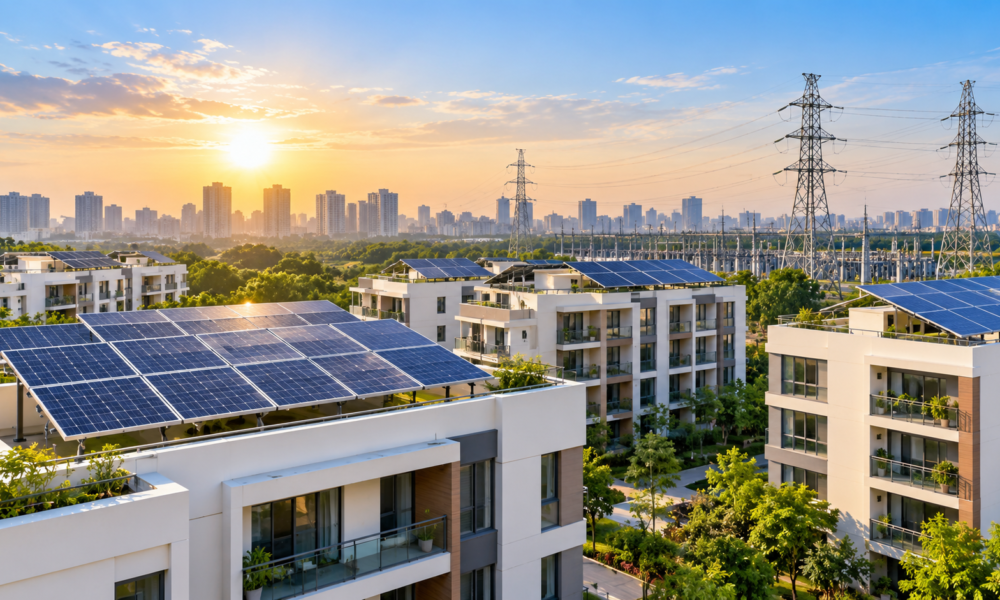
India’s energy infrastructure is undergoing a quiet transformation, and increasingly, it is happening on the roofs of ordinary homes.
The country’s rooftop solar programme has crossed a major milestone, with more than 50 lakh households benefiting from rooftop solar installations under the government’s PM Surya Ghar: Muft Bijli Yojana.
The programme crossed 50.06 lakh beneficiary households in August 2026, just over two years after its launch. The government has set an ambitious target of taking rooftop solar to 1 crore households, while the renewable energy ministry says rooftop solar capacity under the scheme has reached around 14.8 GW. Nearly 19 lakh households have also reported receiving zero electricity bills for at least some billing periods, depending on their electricity consumption.
But the significance of this expansion goes beyond cheaper electricity bills.
Rooftop solar is gradually turning millions of individual buildings into small energy-generating assets, potentially changing the relationship between homes, power companies and India’s electricity grid.
From passive consumers to energy producers
Traditionally, residential buildings have primarily been consumers of electricity.
Power is generated at large plants, transmitted over long distances and distributed to individual homes through the grid.
Rooftop solar changes part of that equation.
A house equipped with solar panels can generate electricity where it is consumed. When production is sufficient for the household’s requirements, dependence on grid electricity can fall.
This creates a more decentralised energy system in which thousands or even millions of small installations collectively contribute to the country’s electricity infrastructure.
That shift becomes particularly important as India’s electricity demand continues to rise alongside urbanisation, industrialisation, air-conditioning use and the electrification of transport.
The scale is growing rapidly
The pace of rooftop-solar adoption has accelerated sharply.
According to the Ministry of New and Renewable Energy, India had installed 32.59 GW of grid-connected rooftop solar capacity by August 31, 2026. Total installed solar capacity had reached 168.04 GW, making solar one of the largest components of India’s renewable-energy expansion.
The PM Surya Ghar scheme has been a major driver of residential adoption.
The programme was launched in February 2024 with an overall outlay of ₹75,021 crore and a target of installing rooftop solar systems in one crore households by FY 2026-27.
By July 2026, the government reported that nearly 40 lakh rooftop-solar systems had been installed under the programme, benefiting more than 48 lakh households. By August, the number of beneficiary households had crossed 50 lakh.
The government is now aiming to accelerate the programme further. In June 2026, the Union government said it hoped to cross 75 lakh rooftop-solar households by December 2026.
Why this matters for real estate
The rooftop-solar boom is also becoming a real-estate story.
For decades, a building’s value has largely been determined by factors such as location, construction quality, amenities, connectivity and access to services.
Energy efficiency is increasingly becoming another consideration.
A residential building with rooftop solar can potentially offer lower electricity costs and greater protection against rising power expenses.
For housing societies, developers and commercial property owners, rooftop solar can also become part of a broader strategy around energy efficiency.
This could eventually influence how new residential projects are designed.
Instead of treating the roof simply as unused space, developers could increasingly view it as an energy-generating asset.
Housing societies could become important
India’s apartment and housing-society ecosystem presents a particularly interesting opportunity.
Large residential societies have substantial electricity requirements because of common-area lighting, lifts, pumps, security systems, clubhouses and other facilities.
Rooftop solar can potentially help offset some of this consumption.
The challenge is that apartment buildings have limited roof space relative to the number of residents.
This means the economics and design of rooftop solar can be different for an independent house compared with a high-rise residential complex.
As India’s cities become increasingly vertical, developers, resident welfare associations, electricity distribution companies and solar installers will need to work out models that make rooftop generation practical for multi-storey buildings.
Government support is reducing the entry barrier
One reason rooftop solar adoption has accelerated is the combination of subsidies and financing support.
Under PM Surya Ghar, residential consumers can receive central financial assistance for rooftop solar installations.
The government has also introduced financing measures intended to make the technology more accessible to middle-income and economically weaker households.
As of July 2026, the government said nationalised banks were offering collateral-free loans for eligible rooftop-solar installations at a concessional rate linked to the repo rate, currently cited at 5.75%, with a 10-year tenure.
This matters because the upfront installation cost has historically been one of the biggest barriers to residential solar adoption.
Reducing that initial financial burden can make rooftop solar more attractive to households that may otherwise struggle to justify the investment.
The DISCOM challenge
However, India’s rooftop-solar expansion also creates a new challenge for electricity distribution companies, or DISCOMs.
The traditional electricity system was designed around large generators supplying electricity to consumers.
A decentralised rooftop-solar system reverses part of that flow.
At certain times, households can generate more electricity than they consume. Depending on the applicable state regulations and system design, excess electricity can interact with the grid.
This requires better metering, grid management, forecasting and distribution infrastructure.
The government has therefore been experimenting with models such as Utility-Linked Aggregation, or ULA, designed to accelerate rooftop-solar adoption, particularly among underserved households.
Under the model, utilities can play a more active role in facilitating installations rather than leaving every household to navigate the process independently.
This could become increasingly important if India wants to move from tens of lakhs of rooftop installations to one crore households.
Solar is becoming part of urban infrastructure
The larger implication is that renewable energy is moving closer to where people actually live.
Solar farms will remain important for India’s energy transition, but rooftop solar adds another layer to the system.
A city with thousands of solar-equipped buildings effectively has thousands of small electricity-generation points distributed across its urban landscape.
This can potentially reduce some dependence on centralised generation and long-distance transmission, although the overall benefits depend heavily on grid design, storage, local electricity demand and regulatory structures.
For urban planners, this means energy infrastructure can no longer be considered completely separate from buildings and real estate.
The roof itself can become part of the energy system.
Construction companies could see a new opportunity
The rooftop-solar expansion is also creating a growing ecosystem around installation and construction.
Solar panels require mounting structures, electrical systems, wiring, inverters, meters and maintenance.
Large housing projects can also require integrated planning during the construction stage.
This creates opportunities for solar developers, engineering companies, electrical contractors, building-material suppliers and technology providers.
For real-estate developers, integrating solar at the design stage could potentially be more efficient than retrofitting systems after a building has already been completed.
That could make renewable-energy infrastructure increasingly relevant to new housing and commercial developments.
What happens when India reaches one crore homes?
The government’s ultimate target under PM Surya Ghar is one crore residential households.
Reaching that number would represent a significant change in India’s distributed-energy landscape.
It would mean millions of individual buildings participating directly in electricity generation.
The challenge, however, will not simply be installing panels.
India will need to ensure that the accompanying grid infrastructure, metering systems, financing mechanisms, installation ecosystem and maintenance services can scale alongside the number of installations.
The quality of installations will also matter.
Poorly designed systems, inadequate maintenance or weak electrical infrastructure could reduce the expected benefits and create additional technical problems.
India’s rooftop-solar expansion represents something bigger than a government subsidy programme.
It sits at the intersection of real estate, construction, energy, technology and urban infrastructure.
The traditional model of urban development was straightforward: build homes, connect them to electricity and supply power from the grid.
The emerging model could look very different
Homes may increasingly be designed not only as places where electricity is consumed but also as places where electricity is generated.
With more than 50 lakh households already benefiting from PM Surya Ghar and the government targeting 1 crore households, that transition has already moved beyond the experimental stage.
The next phase will determine whether India can successfully integrate millions of small solar installations into its wider electricity network.
If it can, the country’s rooftops could become one of its most distributed pieces of energy infrastructure.
And that makes rooftop solar not merely an energy story, but a story about the future of Indian homes and cities.







No Comment! Be the first one.