








India Brings Artificial Intelligence to the Classroom as CBSE Introduces New Curriculum for Young Learners
Artificial intelligence is set to become a part of everyday learning for millions of schoolchildren across India. On the first day of the 2026-27 academic session, Union Education Minister Dharmendra...

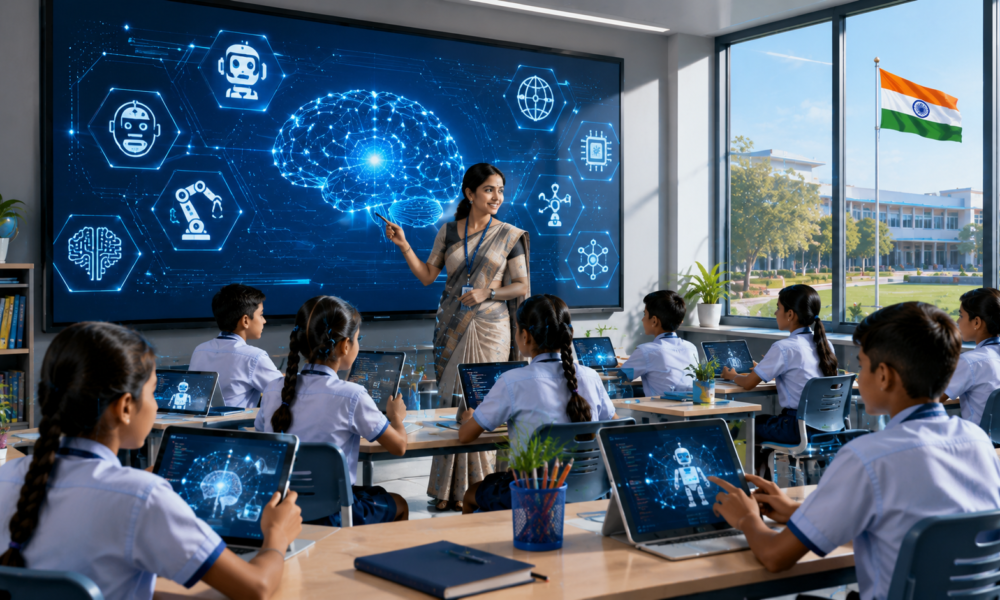
Artificial intelligence is set to become a part of everyday learning for millions of schoolchildren across India.
On the first day of the 2026-27 academic session, Union Education Minister Dharmendra Pradhan launched a new Computational Thinking and Artificial Intelligence curriculum for students of Classes III to VIII under the Central Board of Secondary Education framework. The programme seeks to introduce young learners to the fundamentals of computational thinking, coding concepts and artificial intelligence from an early stage of schooling.
The move marks another step in India’s attempt to align school education with the changing demands of the digital economy. Artificial intelligence has moved beyond the boundaries of research laboratories and technology companies. It increasingly shapes everyday experiences, from online searches and digital payments to healthcare services and personalised learning platforms. Policymakers now believe that students must understand these technologies not merely as users but as informed participants in a rapidly changing world.
The newly introduced curriculum is designed to emphasise logical reasoning, problem-solving and creativity. Rather than focusing only on coding syntax or technical jargon, the programme aims to help students develop structured thinking and understand how digital systems function. Educational experts have long argued that computational thinking is becoming a foundational skill, much like mathematics and language learning.
The decision also reflects a broader shift in India’s education policy. The National Education Policy, announced in 2020, called for a more multidisciplinary and skills-oriented approach to learning. It advocated reducing dependence on rote memorisation and encouraging inquiry-based education that equips students with practical competencies relevant to the twenty-first century.
Artificial intelligence education at the school level has gained momentum globally. Countries including Singapore, the United Kingdom and South Korea have introduced elements of coding and computational thinking into their school curricula. India, with one of the world’s largest school-going populations and a rapidly expanding digital economy, faces the challenge of preparing its future workforce for technology-driven industries.
Industry leaders have repeatedly highlighted the widening gap between technological advancement and workforce preparedness. The demand for professionals with digital and analytical capabilities is rising across sectors, including manufacturing, finance, healthcare, media and public administration. Introducing foundational AI concepts during school years is expected to create familiarity with emerging technologies and encourage students to pursue careers in science, technology and innovation.
The initiative may also contribute to reducing the digital divide by making technology education accessible to students across different regions and socio-economic backgrounds. Since the curriculum is being introduced through the CBSE system, schools across urban and semi-urban India will have an opportunity to integrate new learning methods into classrooms.
Implementation, however, will depend significantly on teacher preparedness and school infrastructure. Experts have stressed the need for teacher training programmes, appropriate learning resources and equitable access to digital tools. The success of the curriculum will ultimately rest on whether schools can move beyond textbook instruction and create meaningful learning experiences that encourage experimentation and critical thinking.
For India’s education system, the introduction of artificial intelligence at the elementary and middle school levels represents more than the addition of another subject. It signals an attempt to prepare a generation of students for a future where understanding technology may become as essential as reading and writing themselves.









No Comment! Be the first one.