



Why India’s Cruise Tourism Boom Is Creating a New Coastal Infrastructure Economy
For decades, India’s coastline primarily functioned as an economic engine for trade and cargo movement. Ports were designed to move containers, petroleum products and industrial goods...

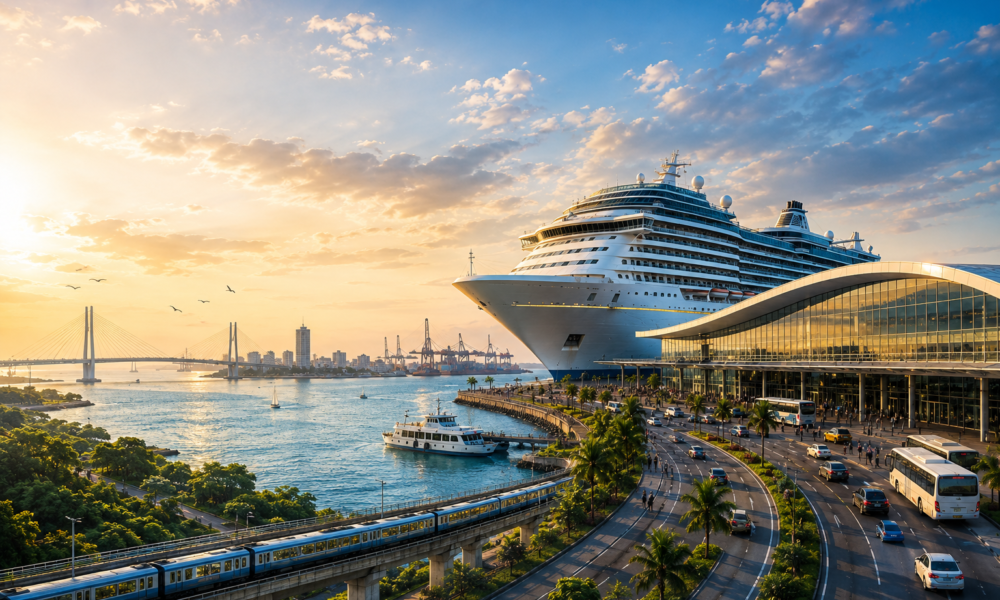
For decades, India’s coastline primarily functioned as an economic engine for trade and cargo movement. Ports were designed to move containers, petroleum products and industrial goods efficiently across the country and to international markets. Tourism, despite India’s vast coastline spanning more than 7,500 kilometers, remained largely peripheral to port-led development.
That equation is beginning to change.
India is witnessing the early stages of a cruise tourism revival that could transform several coastal cities into integrated tourism and economic ecosystems. The rise of cruise tourism is no longer simply about attracting leisure travellers. It is increasingly becoming an infrastructure story involving ports, urban transport, hospitality assets, waterfront redevelopment and regional employment generation.
Mumbai offers perhaps the clearest example of this transition. The city’s harbor, historically associated with shipping and trade, is seeing growing investments in cruise terminals and passenger facilities as authorities position it as a major cruise destination. The emerging cruise economy is encouraging investment in tourism services and waterfront infrastructure that extends beyond the port itself.
The implications of this shift are significant.
Unlike traditional tourists who may spend time in a single city, cruise travellers often visit multiple destinations during one journey. Their movement requires seamless transport networks, modern passenger terminals, improved last-mile connectivity and integrated urban services. This creates demand for infrastructure investments across multiple sectors simultaneously.
Cruise terminals today are evolving into multi-functional economic zones. They increasingly require digital passenger processing systems, retail spaces, hospitality facilities, transport hubs and recreational areas. Such developments can stimulate investments not only within port premises but also across surrounding urban districts.
For India, the opportunity is particularly compelling because cruise tourism can distribute economic activity across secondary cities and coastal regions that have traditionally remained outside mainstream tourism circuits.
Cities such as Kochi, Goa, Chennai, Visakhapatnam and Mangaluru possess natural advantages in terms of coastal access and cultural attractions. Strategic investments in cruise infrastructure could allow these cities to attract international visitors while simultaneously boosting domestic tourism.
The economic multiplier effect of cruise tourism is substantial. Increased passenger movement creates demand for hotels, restaurants, transport services, local retail and cultural experiences. This, in turn, generates employment opportunities across skill levels, ranging from logistics and hospitality professionals to tour operators and small business owners.
The growth of cruise tourism also aligns with India’s broader ambitions of creating experience-led economic destinations. Increasingly, infrastructure planning is moving beyond functional requirements and embracing destination development as an economic strategy.
This approach reflects a larger evolution in how infrastructure is conceptualised in India. Roads, ports and transport systems are no longer viewed merely as physical assets. They are increasingly being developed as enablers of economic ecosystems capable of generating employment, attracting private investment and improving regional competitiveness.
India’s domestic travel market is expanding rapidly, encouraging hospitality companies to significantly increase their presence across the country. This growth in travel demand provides a supportive environment for cruise tourism and associated infrastructure investments.
Yet challenges remain.
Cruise tourism requires coordinated planning between port authorities, state governments, tourism agencies and urban local bodies. Passenger experience depends as much on efficient transport systems and clean public spaces as it does on terminal infrastructure itself.
Environmental sustainability will also become critical. Waterfront development projects must balance economic opportunities with ecological considerations, particularly in fragile coastal ecosystems.
Nevertheless, the broader trajectory appears promising.
India’s next phase of coastal development may not be defined solely by cargo volumes or industrial investments. It could increasingly be shaped by tourism infrastructure that transforms ports into gateways for economic activity, urban regeneration and regional growth.
As cruise ships begin to occupy a larger place in India’s tourism landscape, the country’s coastline is quietly emerging as one of its most important new infrastructure frontiers.



No Comment! Be the first one.