








Jewar Electronics Manufacturing Hub Gets ₹6,750-Crore Push
Jewar in Uttar Pradesh is moving towards a larger role in India’s electronics manufacturing sector following the announcement of two major projects worth about ₹6,750 crore. The foundation...

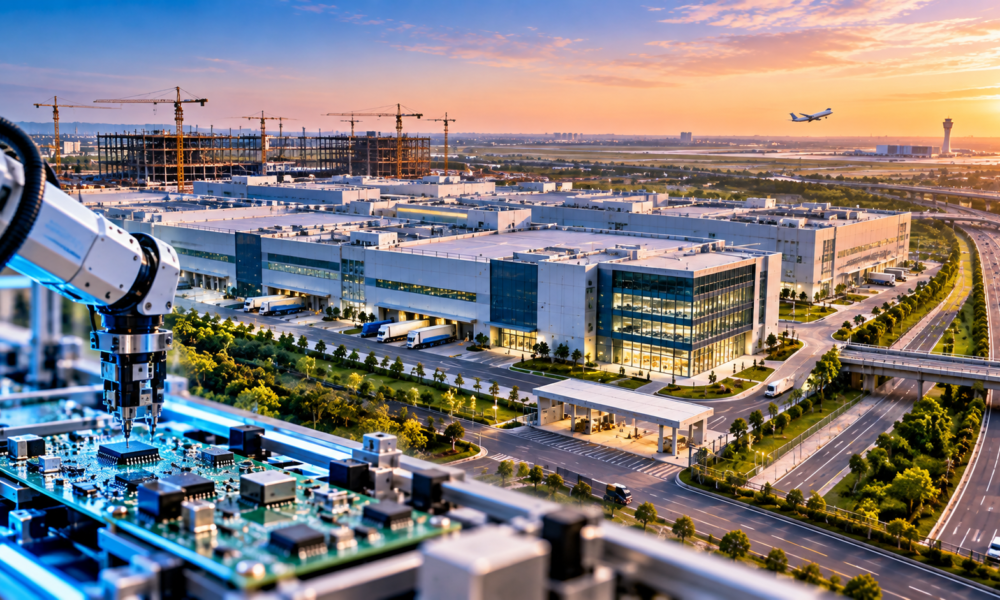
Jewar in Uttar Pradesh is moving towards a larger role in India’s electronics manufacturing sector following the announcement of two major projects worth about ₹6,750 crore.
The foundation stones for the projects were laid at Yamuna City in Gautam Buddha Nagar district on June 27, 2026, by Uttar Pradesh Chief Minister Yogi Adityanath and Union Minister for Electronics and Information Technology Ashwini Vaishnaw, according to the Press Information Bureau.
The projects form part of the state’s wider effort to attract electronics manufacturing investment and build industrial activity around the Jewar region.
Why is Jewar attracting attention?
Jewar is associated with the development of Noida International Airport and the wider Yamuna Expressway industrial region.
Airport infrastructure can improve regional connectivity, while industrial areas can provide space for factories, warehouses and supporting businesses.
However, airport development alone does not guarantee industrial growth. Companies also consider land costs, power supply, water availability, labour, transport costs and access to suppliers.
The region’s ability to attract long-term manufacturing investment will depend on these supporting conditions.
What is planned?
The June announcement covered two electronics manufacturing projects with a combined investment of about ₹6,750 crore. The government also described plans for an electronics manufacturing cluster spread across 206 acres, with support from the central government. The announcement highlighted domestic production of advanced printed circuit boards, which are used in many electronic devices.
Printed circuit boards provide the electrical connections between components in products such as computers, phones, communication equipment and industrial devices.
Local manufacturing can help strengthen the supply chain for electronics companies, although the actual impact will depend on production capacity, product quality and demand.
Why does domestic electronics manufacturing matter?
India uses electronic components across consumer electronics, vehicles, telecommunications and industrial equipment.
Companies may import components when local suppliers cannot provide the required products, prices or production volumes.
Developing domestic manufacturing can give buyers more sourcing options and create opportunities for component makers, suppliers and logistics businesses.
However, local production does not automatically remove dependence on imports. Some advanced materials, machinery and components may continue to come from overseas.
A strong supply chain needs reliable suppliers, technical skills, quality standards and competitive production costs.
How could the region benefit?
Electronics factories can create direct jobs in production, quality control, engineering and maintenance.
They may also create indirect demand for transport, packaging, equipment, security and other business services.
Industrial development can encourage supporting businesses to establish operations nearby. Yet the number of jobs and the scale of the wider economic impact will depend on how quickly the projects become operational and how much production they achieve.
What challenges remain?
Manufacturing companies need reliable electricity, water, roads and waste management services.
They also need a skilled workforce and predictable approval processes. Industrial expansion must be supported by housing, healthcare and transport services for workers.
Projects may face delays during construction, equipment installation or production testing. Announced investment figures should therefore be distinguished from money already spent and facilities already operating.
What comes next?
The next steps include construction, equipment installation, development of the supporting industrial ecosystem and progress towards commercial production.
Jewar’s development illustrates how transport connectivity and industrial planning can work together. Its long-term success will depend on whether the region becomes a competitive manufacturing location rather than simply a destination for announced investment.








No Comment! Be the first one.