








Punjab’s Railway Infrastructure Pipeline Crosses ₹26,000 Crore as New Lines and Station Upgrades Gather Pace
Punjab’s railway infrastructure is entering a major expansion phase, with projects worth more than ₹26,000 crore currently under execution across the state. The investment covers new railway lines,...

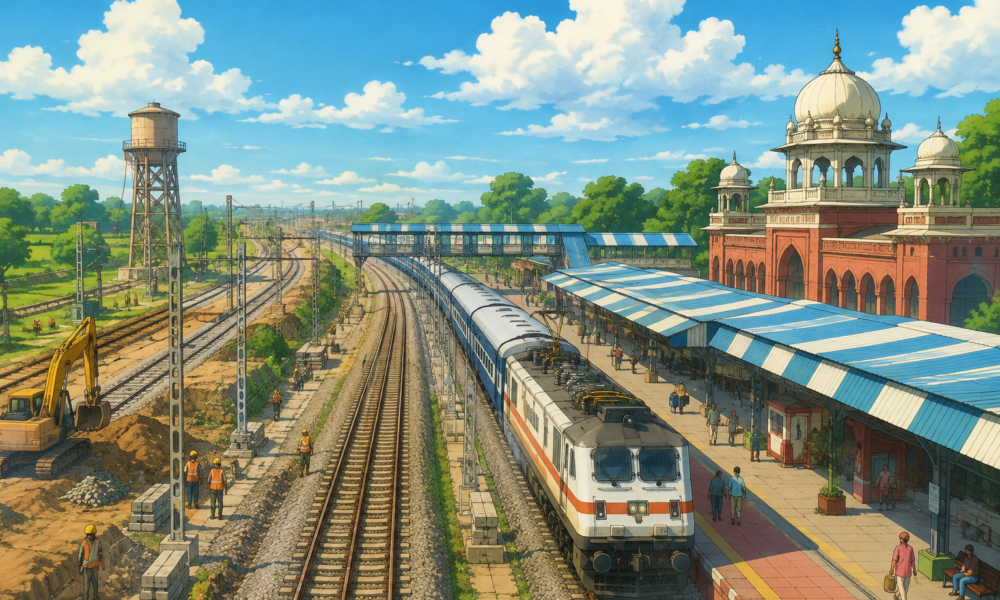
Punjab’s railway infrastructure is entering a major expansion phase, with projects worth more than ₹26,000 crore currently under execution across the state. The investment covers new railway lines, network expansion, station redevelopment and other works aimed at improving passenger and freight connectivity.
The annual average railway allocation for Punjab has risen to ₹5,673 crore for 2026-27, compared with ₹225 crore during 2009-14. The sharp increase in funding is supporting several large projects across the state and neighbouring regions.
One of the biggest projects is the 63-km Bhanupalli-Bilaspur-Beri new railway line, which involves an investment of around ₹13,770 crore. Another important project is the 123-km Nangal Dam-Talwara-Mukerian new line, estimated to cost ₹3,726 crore. These corridors are expected to improve access to areas that have historically had limited rail connectivity.
Punjab has also seen considerable progress in railway construction over the past decade. Around 400 km of new railway tracks have been constructed since 2014, while the state has achieved 100% broad-gauge electrification. More than 400 flyovers and underpasses have also been built to improve safety and reduce conflicts between road and rail traffic.
The expansion has implications beyond passenger travel. Punjab is a major agricultural producer, making efficient freight movement important for transporting wheat, rice, fruits, vegetables and other goods to markets across India. Better rail capacity can help reduce bottlenecks and make the movement of agricultural and industrial products more reliable.
The industrial centres of Ludhiana, Jalandhar, Mohali and Bathinda could also benefit from stronger rail links. Improved connectivity can support the movement of raw materials and finished products while giving businesses another option for moving goods across longer distances.
The state is also seeing investment in individual railway links. In June, the government revived the 39.68-km Qadian-Beas new railway line at an estimated cost of around ₹1,400 crore. The project is expected to improve connectivity in Punjab’s Majha region while supporting tourism and local economic activity.
Station redevelopment is another part of the wider railway upgrade. Under the Amrit Bharat Station Scheme, 30 stations in Punjab have been identified for renovation and modernisation, with work already completed at three stations.
For Punjab, the scale of railway spending is not only about adding tracks. It is about improving links between agricultural markets, industrial centres, towns and tourist destinations. As more projects move from planning to construction, the state’s railway network could play a larger role in freight movement, regional development and economic activity.
The wider investment also reflects the growing focus on rail infrastructure as India works to improve transport capacity and reduce pressure on road networks.








No Comment! Be the first one.