




How Localisation is Powering India’s Railway Manufacturing Revolution
India’s railway manufacturing sector is undergoing one of its biggest transformations in decades. Once heavily dependent on imported technology and components, the country is steadily building...

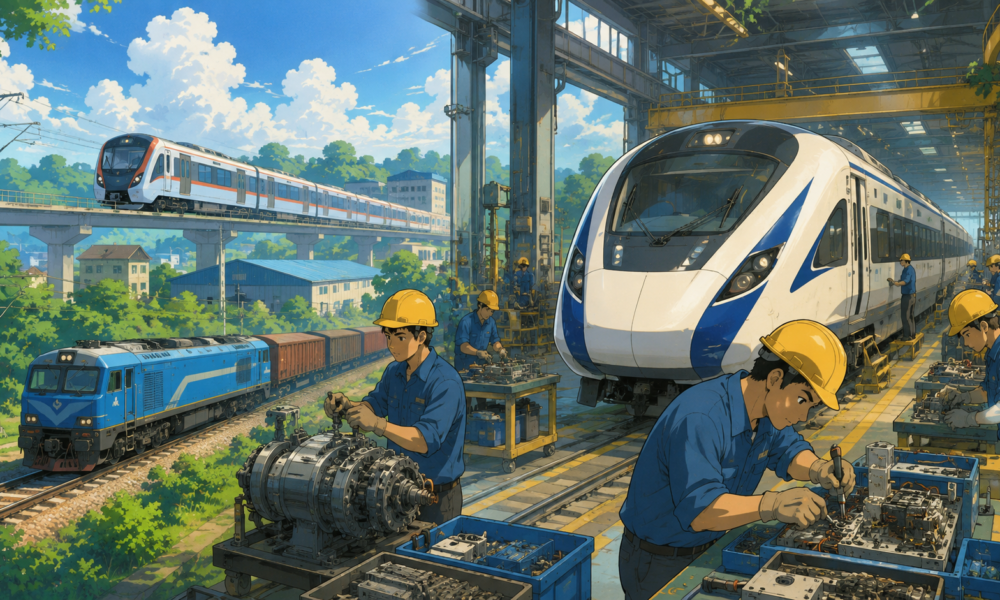
India’s railway manufacturing sector is undergoing one of its biggest transformations in decades. Once heavily dependent on imported technology and components, the country is steadily building a domestic manufacturing ecosystem that now produces modern trains, high-powered locomotives and critical railway equipment within India. This shift is strengthening the country’s industrial base while positioning India as an emerging global supplier of railway technology.
The change has been driven by government initiatives such as Make in India and Atmanirbhar Bharat, which encourage domestic manufacturing and technology development. Over the past decade, railway projects have increasingly included localisation requirements, allowing global manufacturers to establish production facilities in India while sourcing a growing share of components from Indian suppliers. Foreign direct investment has also supported the development of modern manufacturing plants and supply chains.
One of the strongest examples of this transformation is the Electric Locomotive Factory at Madhepura in Bihar. Operated through a joint venture with Alstom, the facility manufactures WAG-12B electric freight locomotives capable of hauling 6,000-tonne freight trains on the Dedicated Freight Corridors. Over the years, localisation at the factory has increased to nearly 90%, with most components now sourced from Indian manufacturers. The project has demonstrated how international technology can be combined with local manufacturing to build advanced railway equipment in India.
The Vande Bharat Express has become another milestone in India’s localisation journey. Developed by the Integral Coach Factory in Chennai, the semi-high-speed train was designed and manufactured in India using largely indigenous engineering. Today, around 90% of its components are produced domestically, creating opportunities for hundreds of Indian suppliers. The government’s ambitious plan to expand the Vande Bharat fleet in the coming years further strengthens demand for locally manufactured components and systems.
India’s rapid regional rail programme is also contributing to the growth of domestic manufacturing. The Namo Bharat trains operating on the Delhi-Meerut RRTS corridor were manufactured in Gujarat with more than 80% localisation. The project has generated business for Indian companies involved in rolling stock, electrification, signalling, station equipment and systems integration, while introducing advanced rail technologies to the country.
The country’s ambitions extend beyond conventional rail systems. India has developed its first hydrogen-powered train, designed by the Research Designs and Standards Organisation (RDSO) and manufactured by the Integral Coach Factory. Although hydrogen technology is still at an early stage, the programme could create new opportunities for domestic manufacturers involved in fuel cells, hydrogen storage systems and power electronics.
Despite significant progress, challenges remain. While localisation in manufacturing has improved considerably, several advanced technologies, including certain signalling systems, propulsion equipment and specialised electronics, still rely on foreign expertise. Many MSMEs also face difficulties in meeting the quality standards, certification requirements and production volumes demanded by large railway projects. Continued investment in research, technology development, workforce training and supplier capability will be essential to strengthen the ecosystem further.
India’s railway manufacturing story is now evolving from one of import dependence to industrial capability. With growing domestic production, expanding exports and sustained public investment, localisation is becoming a key driver of the country’s railway sector. The next phase will depend not only on manufacturing more trains in India but also on developing indigenous technologies that can compete in global railway markets.



No Comment! Be the first one.