







Goa’s Green Infrastructure Drive Puts Communities at the Heart of Sustainable Development
Goa is strengthening its commitment to sustainable infrastructure by encouraging local communities to play a greater role in maintaining the state’s green assets. Chief Minister Pramod Sawant...

Goa is strengthening its commitment to sustainable infrastructure by encouraging local communities to play a greater role in maintaining the state’s green assets. Chief Minister Pramod Sawant has called on young people and women self help groups to become ambassadors for waste management and environmental conservation, highlighting that clean and well-maintained public infrastructure is essential to the state’s long-term growth strategy.
Speaking at an event recognising women entrepreneurs involved in Goa’s homestay initiative, the Chief Minister said the government spends substantial amounts each year on maintaining trees, shrubs and landscaped stretches along national highways, as well as on waste collection across coastal areas and major roads. He stressed that greater community participation could improve efficiency while creating new livelihood opportunities for residents.
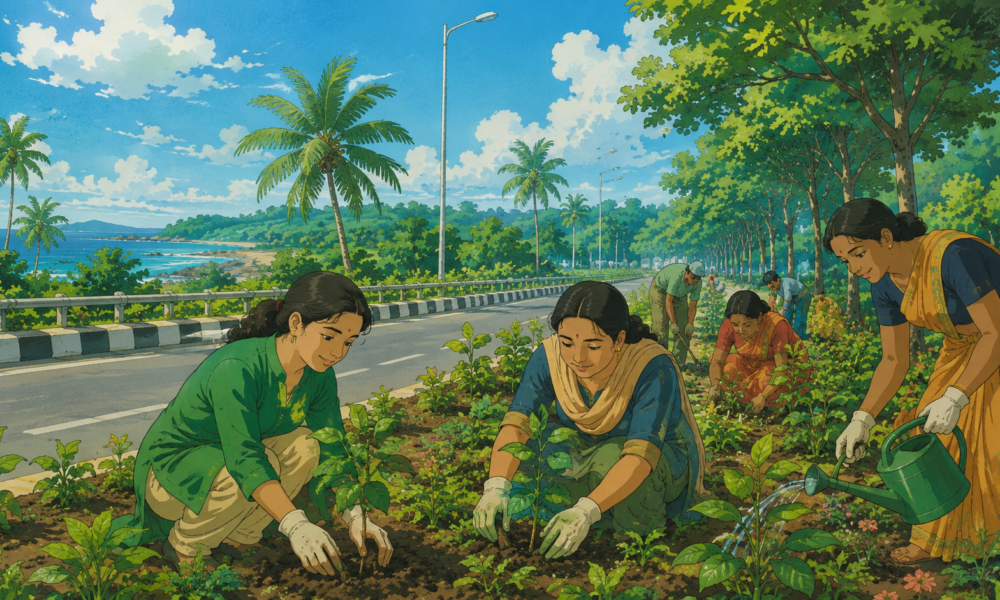
One of the state’s key initiatives is the ongoing plantation drive along the national highway corridor stretching from Patradevi in North Goa to Pollem in the south. The green corridor forms part of Goa’s broader environmental vision, aimed at improving roadside landscapes, enhancing biodiversity and creating a more sustainable transport network. The initiative also complements the state’s recently launched ‘Green Goa, Clean Goa’ movement, which seeks to increase public participation in environmental protection and climate action.
Rather than depending entirely on external contractors, the government has proposed involving local women’s self-help groups in maintaining stretches of roadside plantations. Under the proposal, these groups would be paid to look after designated sections of highway, ensuring trees are protected, maintained and nurtured over the long term. The model not only supports environmental conservation but also creates an additional source of income for rural communities.
This approach reflects a growing shift in infrastructure planning across India, where sustainability is increasingly viewed as an integral part of project development rather than an afterthought. Roads, highways and public spaces are now expected to deliver environmental and social value alongside improved connectivity.
Waste management remains another important pillar of Goa’s infrastructure strategy. Tourism continues to be one of the state’s largest economic drivers, making cleanliness and environmental quality essential to maintaining its global appeal. According to the Chief Minister, visitors are more likely to return when destinations remain clean, green and visually attractive, reinforcing the direct connection between environmental infrastructure and economic development.
Alongside environmental initiatives, the state is also exploring new opportunities to strengthen sustainable tourism. Goa is developing a larger network of homestays across rural and hinterland regions, encouraging visitors to experience local culture while creating employment for women entrepreneurs. Government supported training programmes and financial assistance have helped several women establish homestay businesses, contributing to community based tourism and rural economic growth.
The focus on community participation demonstrates how infrastructure extends beyond physical construction. Green corridors, roadside plantations, waste management systems and sustainable tourism all depend on long term maintenance and public involvement to remain successful.
As India continues investing in modern infrastructure, Goa’s approach offers an example of how environmental stewardship can be integrated into development planning. By combining public investment with local participation, the state is working towards infrastructure that supports economic growth while preserving natural assets for future generations.
The initiative also reflects a wider trend in infrastructure development where sustainability, community engagement and climate resilience are becoming essential components of successful projects. Clean roads, protected green spaces and effective waste management are increasingly recognised as infrastructure assets that improve quality of life, strengthen tourism and contribute to long term regional development.








No Comment! Be the first one.