








India Demonstrates 60% Recycled Asphalt Technology on Chennai–Tirupati Highway
India has taken a significant step towards more sustainable road construction with the successful field demonstration of a highway pavement containing 60% Reclaimed Asphalt Pavement (RAP) on National...

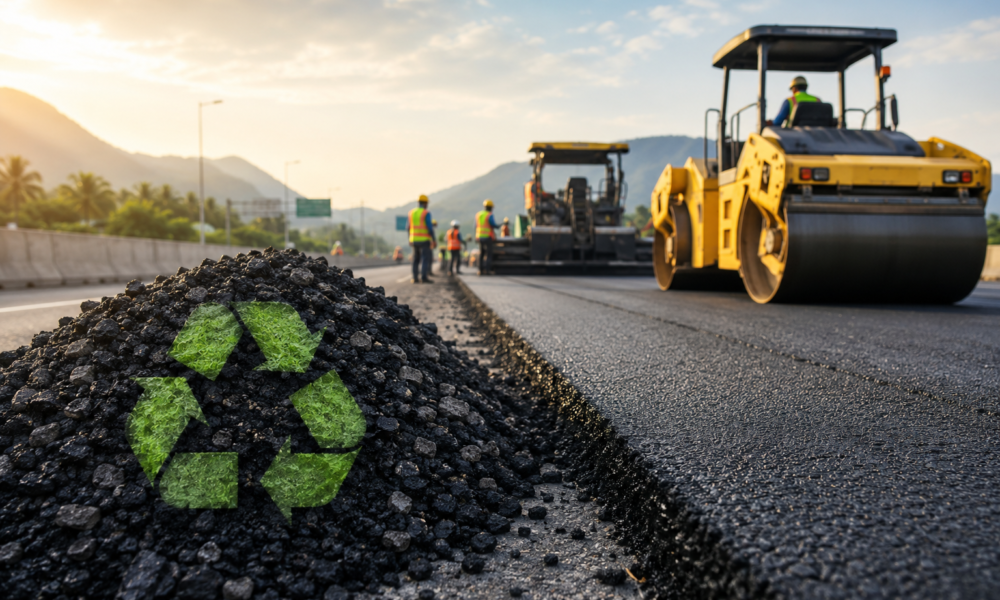
India has taken a significant step towards more sustainable road construction with the successful field demonstration of a highway pavement containing 60% Reclaimed Asphalt Pavement (RAP) on National Highway-716, part of the Chennai–Tirupati Package-I.
The demonstration was carried out by the CSIR-Central Road Research Institute (CSIR-CRRI) in collaboration with Oriental Structural Engineers Private Limited (OSEPL) and Ooms Polymer Modified Bitumen Pvt. Ltd. (Ooms India). The trial was conducted under actual highway construction conditions, rather than being limited to laboratory testing.
RAP is material recovered from existing asphalt roads. Instead of treating old pavement as waste, the material can be processed and reused in new road construction. It contains aggregates and aged bitumen, both of which can be recovered and incorporated into new asphalt mixes after appropriate testing and treatment.
The NH-716 demonstration used 60% RAP in the Dense Bituminous Macadam (DBM) layer. The process covered the complete recycling chain, including recovery and processing of old pavement material, characterisation, rejuvenation, mix design, hot-mix plant production, laying and field compaction.
A key part of the trial was REJUBIT, an indigenous RAP rejuvenator jointly developed by CSIR-CRRI and Ooms India. The technology is designed to restore important properties of aged bitumen contained in reclaimed asphalt, helping engineers use a higher proportion of recycled pavement material in new mixes.
The demonstration could have wider implications for India’s road sector. Highway construction requires large quantities of aggregates and bitumen. Greater use of recovered pavement materials could reduce the need for virgin raw materials while also reducing construction waste.
CSIR-CRRI described reclaimed asphalt as a valuable engineering resource rather than simply waste. The institute said that higher RAP utilisation can support a more circular approach to highway construction, in which material from existing roads is recovered and used again in future projects.
The project also highlights the importance of quality control. Reusing asphalt at high percentages is not simply a matter of adding old material to a new mix. RAP needs to be properly characterised, while the properties of its aged binder must be assessed. Mix design, rejuvenation and construction controls are also required to ensure the recycled material meets the necessary engineering requirements.
The field demonstration therefore represents a move from research towards practical highway construction. CSIR-CRRI said that such trials can generate field experience and help build confidence among road agencies, contractors and other stakeholders before wider adoption.
For Tamil Nadu, the demonstration has particular relevance because of its extensive road network. The Highway Research Station in Chennai said the state’s existing pavements could provide considerable scope for recycling materials, potentially reducing demand for virgin aggregates and bitumen.
The development comes as India continues to expand its road network while also looking for ways to make infrastructure development more resource-efficient. If high-RAP technologies can be adopted on suitable projects without compromising pavement performance, old roads could increasingly become sources of material for new construction.
The NH-716 trial offers an example of how recycling, domestic technology and infrastructure development can come together. Its next significance will lie in generating enough field evidence to determine where and how high-RAP construction can be used at a larger scale.









No Comment! Be the first one.