







Kolkata Metro Purple Line Advances with Major Tunnel Breakthrough at Victoria Station
Kolkata Metro has achieved a major construction milestone with the successful breakthrough of Tunnel Boring Machine (TBM) Durga at Victoria station, marking the completion of a critical underground...

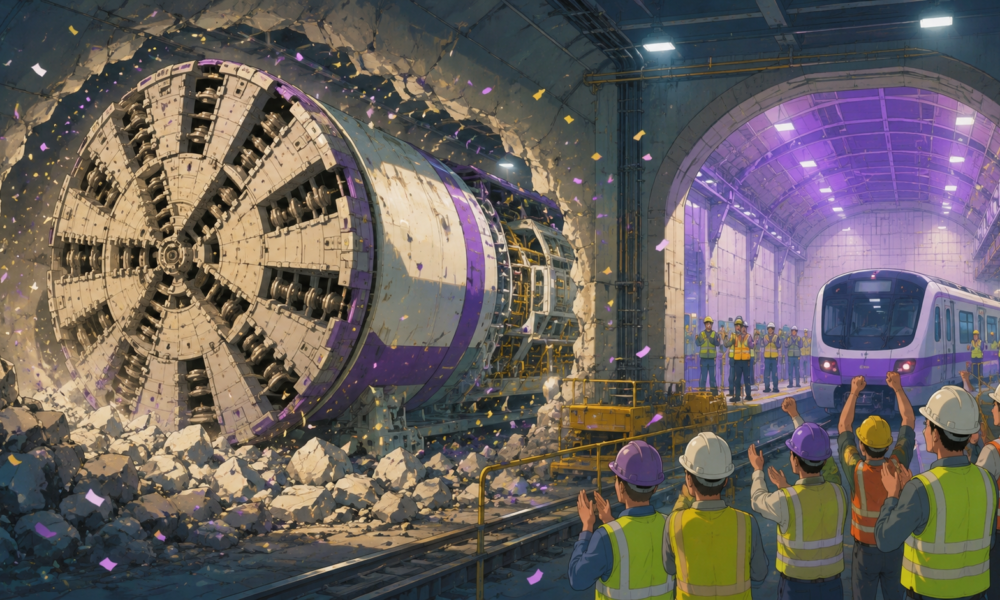
Kolkata Metro has achieved a major construction milestone with the successful breakthrough of Tunnel Boring Machine (TBM) Durga at Victoria station, marking the completion of a critical underground tunnel section on the Purple Line. The development strengthens the city’s expanding metro network and represents another important step towards improving urban mobility in eastern India.
The tunnel breakthrough connects Khidderpore and Victoria stations, completing one of the most technically challenging stretches of the corridor. Underground metro construction in densely populated urban areas requires careful planning to minimise disruption to roads, heritage structures and existing utilities. The successful completion of this section demonstrates the engineering capabilities involved in delivering modern transport infrastructure beneath an active city.
TBM Durga began its tunnelling journey in July 2025 and completed the excavation after safely passing through complex geological conditions beneath central Kolkata. Project officials described the breakthrough as a result of coordinated planning, advanced engineering and continuous monitoring throughout construction. The work was completed without major disruption to surface traffic or surrounding infrastructure, highlighting the growing use of precision tunnelling technologies in India’s metro projects.
The Purple Line forms an important part of Kolkata Metro’s long-term expansion strategy. Once operational, the corridor will improve connectivity between key residential, commercial and institutional areas while reducing travel time for thousands of daily commuters. Better public transport infrastructure is expected to encourage greater use of mass transit, easing congestion on city roads and contributing to lower vehicle emissions.
Metro rail projects have increasingly become catalysts for wider urban development. Improved connectivity often supports commercial activity, increases demand for mixed-use developments and enhances accessibility to business districts. As stations become transport hubs, they also encourage investments in retail, office space and residential projects in surrounding areas.
The latest tunnelling milestone also highlights the role of advanced construction technologies in India’s infrastructure sector. Tunnel boring machines allow engineers to construct underground corridors with greater accuracy while reducing the need for large-scale excavation on the surface. This approach is particularly valuable in historic cities such as Kolkata, where protecting heritage buildings and maintaining daily traffic movement remain key priorities during construction.
India has significantly expanded its metro rail network over the past decade, with projects underway in multiple cities including Delhi, Bengaluru, Chennai, Pune, Ahmedabad and Patna. These investments reflect a broader national strategy to improve urban mobility through reliable, sustainable and high-capacity public transport systems.
For engineering companies, metro projects continue to generate demand across tunnelling, civil construction, electrical systems, signalling, rolling stock and station development. Each new corridor creates opportunities for technology providers, contractors and infrastructure specialists while supporting employment across the construction value chain.
The successful tunnel breakthrough at Victoria station represents more than a construction milestone. It demonstrates how modern engineering solutions are helping cities expand transport infrastructure within challenging urban environments while maintaining safety and operational efficiency.
As work progresses on the remaining sections of the Purple Line, Kolkata moves closer to adding another important transport corridor to its metro network. The project is expected to strengthen urban connectivity, support economic activity and improve commuting options, reinforcing the growing role of metro infrastructure in shaping India’s future cities.






No Comment! Be the first one.